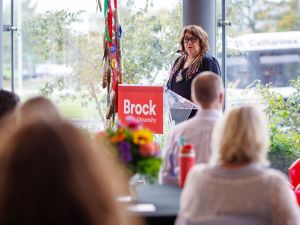
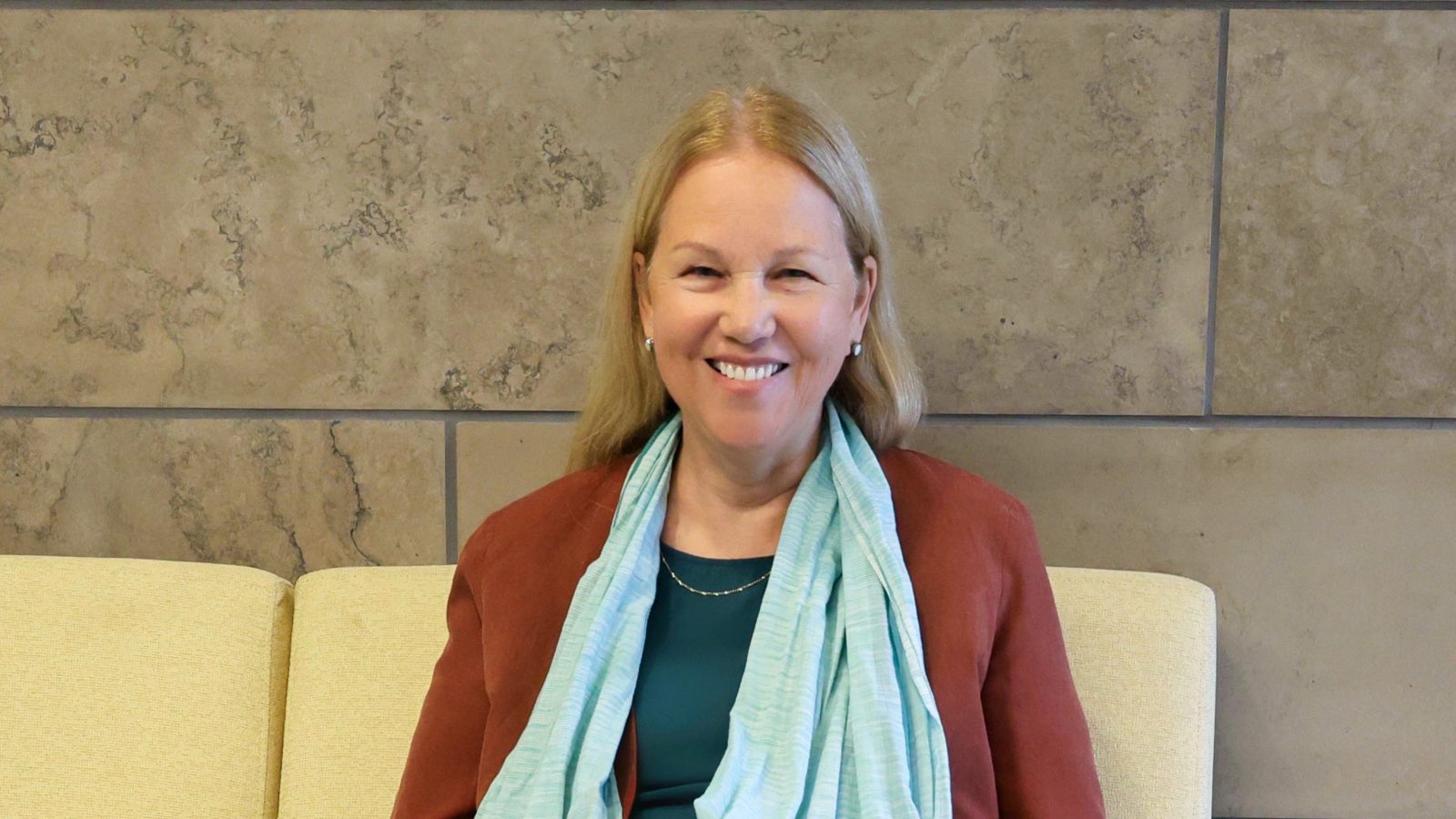
 Distinguished Professor Andrea Doucet in the Department of Sociology and the Centre for Women’s and Gender Studies held a Tier 1 Canada Research Chair in Gender, Work and Care from 2011 until 2025.
Brock University’s Distinguished Professor designation is a lifetime appointment recognizing outstanding achievement in each recipient’s academic discipline. This series of articles highlights this year’s recipients. Read more about the award and its recipients on The Brock News.
When Andrea Doucet was a new mom, and busy PhD student at Cambridge University, she was puzzled by her husband’s experiences with bringing their baby to parenting groups.
“He was treated as either a rock star, a loser or a pervert,” says Doucet, who was recently named one of Brock’s newest Distinguished Professors. “I was really interested in why men who had a capacity to care were treated differently on the social landscapes of parenting.”
That observation deepened her interest in care work.
She ultimately published an award-winning book, Do Men Mother?, based on her interviews with over one hundred Canadian fathers that is now in its second edition.
“I always tell students that there are questions that will keep you awake at night and that you will puzzle over — you can’t figure them out or you feel like you’re up against something,” she says. “Those are the questions you should pursue.”
Doucet joined Brock’s Department of Sociology and Centre for Women’s and Gender Studies as a Tier 1 Canada Research Chair in Gender, Work and Care in 2011.
She says her early experience as a researcher for the United Nations Development Program trained her in the value of listening, while her undergraduate courses in creative writing influence the way she tells stories from her research findings.
As a result, her work often resonates across academic, government and general audiences, which she says helps her meet her goal of “enhancing the public conversation and feeding into change.”
When Doucet and research colleagues Lindsey McKay and Sophie Mathieu uncovered inequities in Canada’s parental leave policy, for example, they took their concerns to Parliament Hill.
“We think of Canada as having a parental leave policy that reaches everybody, but we’ve demonstrated that many women, especially low-income women, are not receiving paid parental benefits,” she says. “We testified at the House Commons and we’re still working on this issue.”
Doucet now co-coordinates the International Network of Leave Policies and Research, a global network of parental leave experts.
Change-making research collaborations have long been part of Doucet’s work. She points to a highly collaborative project on Indigenous unemployment, initiated by the Fort Erie Native Friendship Centre (FENFC) and led by then post-doctoral fellow Eva Jewell. Their report helped the FENFC improve government financing of their employment programming, and Doucet and Jewell continue to work on several projects together.
Today, Doucet is the Principal Investigator and Project Director of the Social Sciences and Humanities Research Council (SSHRC) Partnership project, “Reimagining Care/Work Policies,” which funds researchers and students across Canada.
While she began her academic career focusing on care policies for children, her recent work calls for care leaves and care time across the life course, and she highlights the interconnectedness of care issues and ecological issues.
Although collaboration requires time and attention, it pays off, according to Doucet.
She says she feels privileged to lead “partnerships that are transdisciplinary and transcultural with diverse scholars and people.” She notes that large projects require steady management and acknowledges the excellent work of her Project Manager, Jennifer Turner.
Doucet also values the insights from her post-doctoral fellows and students.
“It’s cross-generational mentoring,” she says. “For me, it’s one of the most meaningful parts of this work.”
Over her career, Doucet has earned a global reputation as a care scholar, appearing on Stanford University’s list of the world’s top two per cent of scientists by citations in 2019, 2022, 2023 and 2024.
She was named the Faculty of Social Sciences Distinguished Researcher of 2020 and recognized with Brock’s Distinguished Research and Creative Activity Award in 2022. In 2025, she received the Mirabelli-Glossop Award from the Vanier Institute of the Family.
Doucet was also a founding member of Brock’s Social Justice Research Institute and has served as the Director of the Brock Research Studio for Visual, Narrative and Digital Methods since 2014.