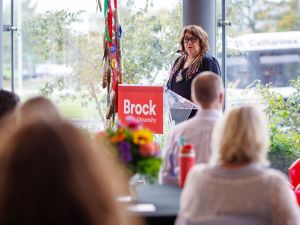
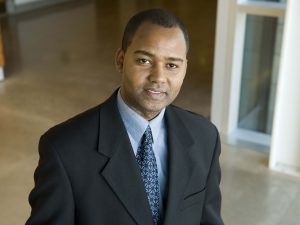
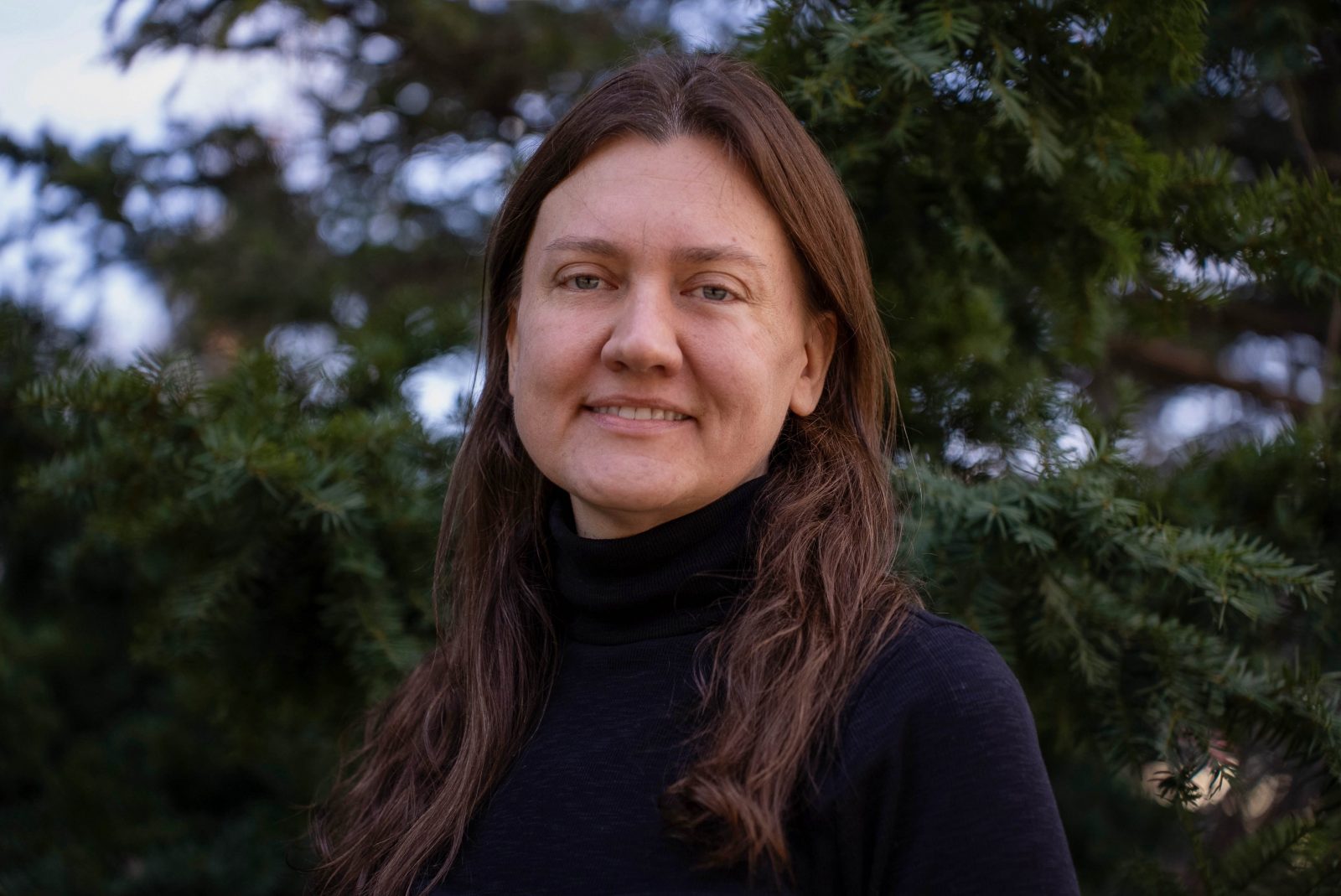
 Sandra Rehan (BSc ’07, PhD ’11) recently received the 2025 Brock University Faculty of Mathematics and Sciences Distinguished Graduate Award.
An early encounter with small carpenter bees in her parents’ garden set Sandra Rehan (BSc ’07, PhD ’11) on the path towards a career researching wild bees.
Now an international bee ecology expert, Rehan recently received the 2025 Brock University Faculty of Mathematics and Sciences Distinguished Graduate Award.
The Biology graduate credits the mentors she found at Brock with helping her build confidence as a researcher.
“Brock gave me the space to explore ideas,” Rehan recalled. “Professors didn’t just teach facts, they nurtured curiosity and made discovery feel accessible.”
When a professor mentioned an open research assistant position during class, she applied. That formative experience fueled her enduring fascination with wild bees — particularly the small carpenter bee in particular, which remains a cornerstone of her research.
Rehan’s early observations and studies uncovered surprising social structures, particularly the “dwarf sister,” an underfed bee who forgoes reproduction to care for her siblings.
“It amazed me that such tiny creatures had these complex family dynamics,” said Rehan. “Studying the dwarf sister opened up bigger questions about cooperation, sacrifice and the evolution of social behaviour.”
Since she graduated from Brock, Rehan has conducted bee ecology research around the world.
In Australia, she combined extensive fieldwork with emerging genetic lab techniques to examine unique ecological conditions, while working in Panama’s tropical ecosystems offered insights into the diversity of bee behaviour.
Later, in New Hampshire, she studied bee populations in agricultural settings and explored how farming practices affect bee health. Further collaborations in the U.S. deepened her expertise in microbiome research, genomics and next-generation sequencing.
Today, she serves as Professor Biology at York University and Director of its Centre for Bee Ecology, Evolution and Conservation, where she investigates bee health with applications beyond entomology.
Her work studies the complex diets of wild bees and how nutrition influences health and survival. By analyzing key nutrients, such as fatty acids and sugars, Rehan connects foundational bee biology to applied research on population resilience.
“If we understand what makes a healthy bee, we can better understand how to support pollinators in changing environments,” she said.
Her investigations also document native bee declines using historical records while testing innovative strategies such as probiotics and microbiome restoration. This combination of curiosity-driven and applied research reflects her broader mission to use science in service of biodiversity and ecosystem health.
“Pollinators are at the heart of food security and environmental stability,” she said. “When we protect bees, we’re also protecting ourselves.”
Building global connections has been a key element of her success.
“Science thrives on collaboration,” she said. “Working across ecosystems and countries helps us to see how interconnected our challenges — and solutions — really are.”
Her international collaborations and innovative research methods have earned her numerous distinctions, including a Tier II York Research Chair in Behavioural Genetic and Molecular Ecology; Fellowships with the Royal Society of Canada, Linnean Society and Royal Entomological Society; and recognition as a National Geographic Explorer and TEDx Fellow.
Her research has been funded by agencies such as the Natural Sciences and Engineering Research Council of Canada, Environment Climate Change Canada, National Geographic and the Foundation of Food and Agricultural Research, and published in leading journals such as Nature Communications, American Naturalist, Proceedings of the National Academy of Sciences and Molecular Ecology.
She is also the author of two books, Wild Bees of New England and Wild Bees of Eastern North America: a guide to common pollinators and flowers.
As an educator, she encourages students to think critically about information in an era of digital media and ever-evolving technology.
“I want students to question assumptions, look at primary data and understand how science actually works,” she said. “That kind of thinking prepares them not just as scientists, but as informed citizens.”