Social Justice and Equity Studies graduate Janice Desroches (BA ’03, TESC ’04, MA ’05, MA ’25) returned to Brock to complete research on equity-focused professional development for teachers. Desroches graduated, and received a program achievement award, during the University’s 118th convocation on Friday, Oct. 17.
When Brock graduate Janice Desroches (BA ’03, TESC ’04, MA ’05, MA ’25) was called upon to be a better ally during an equity-focused reading circle in 2021, she didn’t know it would lead her back to the University.
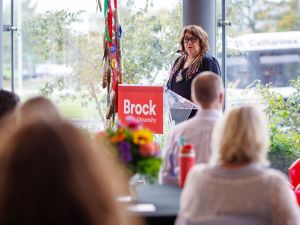
The language educator says the “transformative” experience prompted her to start a new venture and ultimately motivated her to pursue a master’s in Social Justice and Equity Studies. She received her degree on Friday, Oct. 17 during the Brock’s 118th Convocation.
Desroches and her twin, Jennifer Looney, created Chapters4Change to engage local teachers in literature circles with the goal of strengthening allyship in and beyond the classroom.
Since Desroches and Looney launched their program in 2022, participating teachers from Ontario school boards have met weekly to share insights and experiences as they read through social justice and equity focused books such as Jeannie Gainsberg’s The Savvy Ally or Layla Saad’s Me and White Supremacy.

Janice Desroches (BA ’03, TESC ’04, MA ’05, MA ’25), right, and her twin, Jennifer Looney, run a professional development organization focused on transformative learning and leadership through reading and dialogue.
As Chapters4Change flourished, Desroches quickly saw the research potential in studying literature circles as a tool for educational settings.
And after spending almost two decades as an English as a Subsequent Language teacher, she was eager to engage in research that could help make classrooms and schools more welcoming to individuals from equity-deserving groups.
“Reflecting on my own time as an educator and a student, seeing barriers to access for certain individuals, I really wanted to make a change and help educate educators about how best to support students,” she says.
Under the supervision of Associate Professor of Educational Studies Leanne Taylor, Desroches’ analyzed the impacts of the nine literature circles she had run to that point by working with four queer-identifying past participants of the Savvy Ally Literature Circle to learn about how the experience shaped their awareness of 2SLGBTQI+ equity and inclusion in elementary and high school.
“From the research side, it was important for me to ensure that participants’ voices were amplified to ensure the work I’m doing is as impactful and successful as possible,” she says.
Desroches says several findings from her research might surprise those who have fixed ideas of what an effective professional development opportunity should look like.
For example, she says the use of an arts-based practice was “powerful in disrupting traditional power dynamics and fostering inclusion.”
And, far from being put off by the level of discomfort they felt, participants who built trust in their circles soon developed an appetite for deeper and more intersectional material to continue their learning journey.
“Short-term literature circles were able to foster not only transformative learning but also leadership capacities in the participants,” says Desroches. “Many assume that meaningful professional development requires long-term, institutional initiatives, yet my research shows that even a grassroots, five-week literature circle can spark empathy, dialogue and equity-driven action.”
Now that her latest degree is complete and she has more time to devote to Chapters4Change, Desroches plans to seek additional feedback from current participants, who are reading David Roberston’s memoir All The Little Monsters and exploring themes of anxiety, depression and meaningful allyship. She also plans to expand feedback mechanisms for participants to include surveys, focus groups and additional individual interviews.
She is reaching out to more school boards in the hopes of expanding the reach of Chapters4Change and developing a guide intended for others interested in using this method for professional development for educators.
“My biggest takeaway from the SJES program is the importance of centring diverse voices in learning spaces,” says Desroches. “I learned so much from the other students within my cohort discussing different issues and coming to our discussions with a variety of different lenses — I feel very thankful to have had the opportunity to learn and grow through those conversations.”