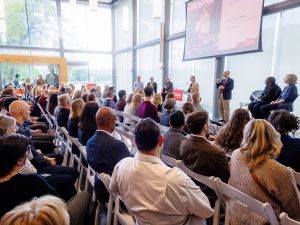
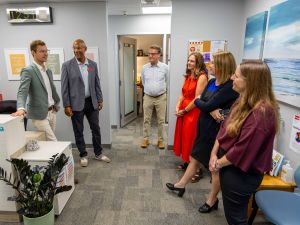
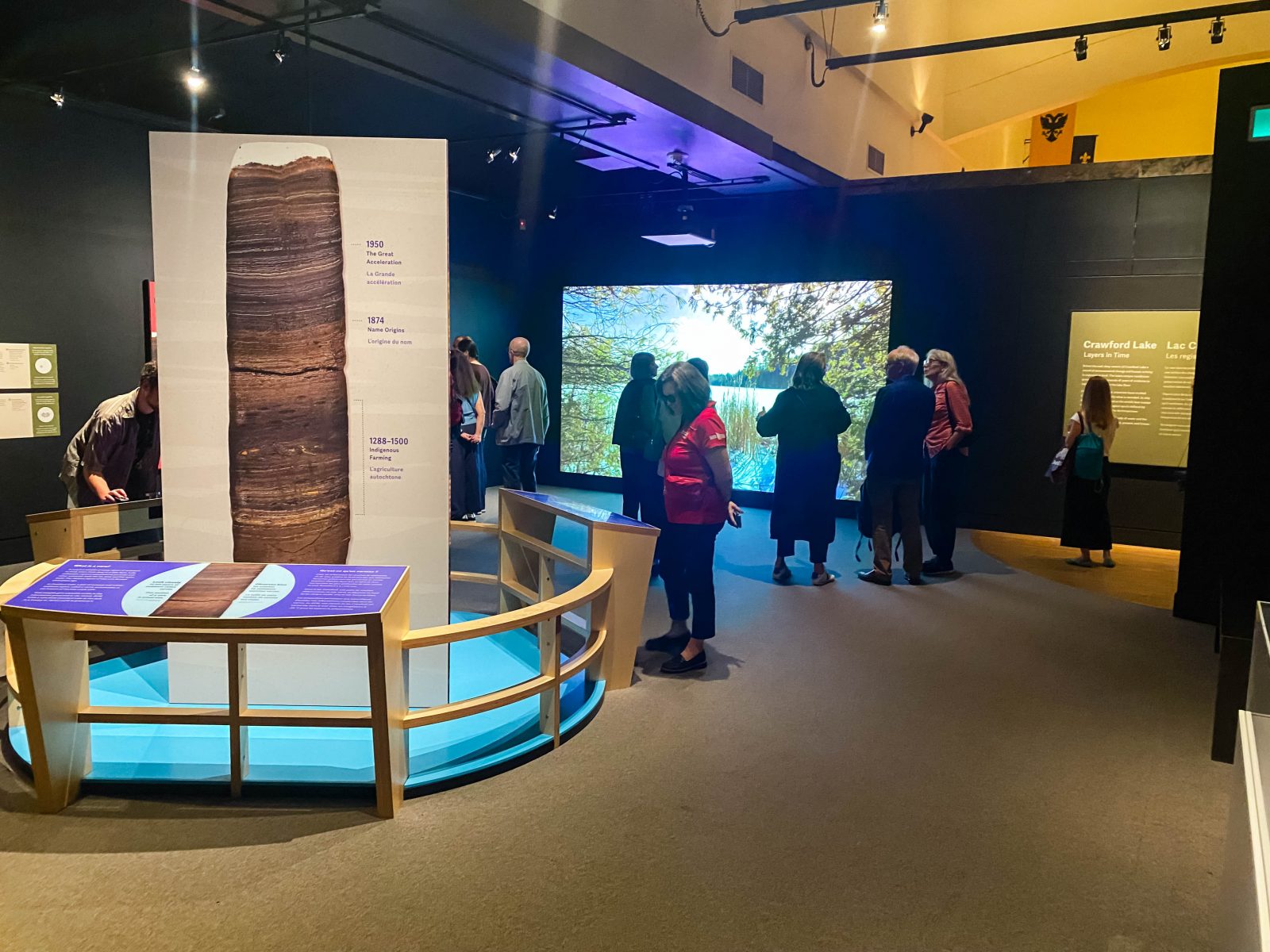
 Brock University President and Vice-Chancellor Lesley Rigg (centre) recently explored the Royal Ontario Museum's Crawford Lake: Layers in Time exhibit, which features research by Professor of Earth Sciences Francine McCarthy.
 For Francine McCarthy, viewing the Crawford Lake: Layers in Time display at Toronto’s Royal Ontario Museum (ROM) was a little like coming home.
The Professor of Earth Sciences, who is internationally renowned for her Crawford Lake research, was at the ROM Sept. 27 for a reception celebrating the exhibit’s opening.
The year-long display features a range of materials — including lakebed core samples and Indigenous and settler objects — collected from the Milton, Ont., body of water and surrounding area that illustrate the impacts of human activity on the planet.

Professor of Earth Sciences Francine McCarthy on site at Crawford Lake.
“It feels like things have come full circle because the ROM is where I did much of my graduate work,” says McCarthy. “This exhibit is a major recognition of the efforts I’ve made to communicate with the general public the importance of environmental sciences and awareness of our environment.”
In the mid-1980s, McCarthy’s master’s research at the ROM investigated the lake level history of Lake Ontario. By then, researchers affiliated with the ROM had been studying Crawford Lake for more than 10 years.
A couple of decades later, McCarthy became interested in studying the record of human activity in Crawford Lake’s sediment layers.
McCarthy’s research is part of a larger initiative within the international community calling for a new epoch, the Anthropocene, to be added to the geologic time scale to reflect the impact of humans on the planet.
She led multi-institutional research teams that collected and examined sediment from the lakebed. The sediment layers, called varves, contained traces of plutonium-239 and fly ash, among other substances, trapped within the organic material.
Also found in the layers were pollen, evidence of Indigenous cultivation activities spanning more than 500 years. This discovery led to excavations and an eventual reconstruction of a 15th century Longhouse Village.
The Lake’s geologic record is so clear that an international body of experts voted to identify Crawford Lake as being the location that best shows the “golden spike,” a marker that shows the boundary between the current Holocene and the proposed Anthropocene.
For the time being, though, Earth is still officially considered to be in the Holocene epoch.
Meanwhile, in 2021, University of Toronto Assistant Professor Soren Brothers joined the ROM as its inaugural Allan and Helaine Shiff Curator of Climate Change. He began working closely with ROM Assistant Curator of Plants Deborah Metsger.
Metsger, who has participated in the Crawford Lake projects and initiatives since she joined the ROM in 1981, says her ongoing association with McCarthy over the years led to the ROM’s current involvement in the Crawford research and collections care.
“The first ‘climate change object’ Soren and I accepted in 2022 was a Crawford Lake core that Dr. McCarthy donated to the ROM,” she says, adding that McCarthy’s team recently donated a second core.
Soren says the new exhibit, for which he is the lead and Metsger is co-curator, is the realization of a long-held dream for the ROM.
“With this exhibition, not only are we able to tell a fascinating story of how intimately intertwined humans and nature are, but it’s been exciting to show how Crawford Lake demonstrates our ability to do things right in our history, whether it’s halting rampant nuclear weapons testing or addressing acid precipitation,” he says. “I hope this fact brings inspiration to visitors when considering our ability to address the global threats we face today associated with the Anthropocene condition.”
McCarthy says the collaborative research history and the wide, eclectic view of history the ROM offers makes it the perfect home for the exhibit.
“It definitely seems fitting that the ROM should tell the story of Crawford Lake,” she says.