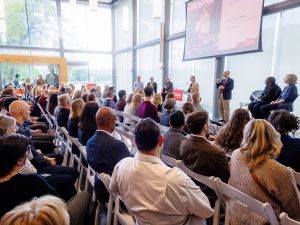
Panagiota (Nota) Klentrou (left), Dean of Brock’s Faculty of Applied Health Sciences, presented Sergio Hernandez (BSc ’16, MSc ’19) with the 2025 Faculty of Applied Health Sciences Distinguished Graduate Award on Sunday, Sept. 21 during the University’s Homecoming celebrations.
Sergio Hernandez (BSc ’16, MSc ’19) moved to New York at the height of the COVID-19 pandemic, facing rolling lockdowns, personal upheaval and the uncertainty of starting over.
The two-time Faculty of Applied Health Sciences graduate was recruited by the New York State Department of Health in 2020, an opportunity he says placed him at the epicenter of infectious disease and immunology.
Now an emerging expert in Lyme disease immunopathogenesis, or the potentially harmful reaction of a patient’s immune system to the disease, Hernandez’ recently received the 2025 Brock University Faculty of Applied Health Sciences Distinguished Graduate Award.
His work aims to transform how scientists and clinicians think about post-treatment Lyme disease and infection-induced immune dysregulation.
Hernandez’ passion for translational research, which aims to bridge research findings with real-world applications, began under the mentorship of Professor of Health Science Ana Sanchez and then PhD candidate Jose Gabrie.
Through his work with Sanchez’ lab, Hernandez went on research trips to under-resourced communities in Honduras where he witnessed the direct benefits science can have on people’s lives.
Outside the lab, Hernandez co-founded Latin Youth United, a peer-support network for international students that addresses cultural gaps and mental wellness, cultivating his ability to mobilize communities.
“The formative years at Brock anchored my scientific excellence and fueled a lifelong commitment to research with public health impact,” he says.
While working with the New York State Department of Health, Hernandez contributed to studies of immune responses to the COVID-19 virus.
“My experience in New York laid the foundation for both my professional and personal growth,” he says. “It reinforced my resiliency both in and out of the lab and deepened my commitment to studying pathogens of public health relevance, including seeding my first investigations into Lyme and other tick-borne diseases.”
In 2022, Hernandez relocated to Boston to continue his research at Massachusetts General Hospital and Harvard Medical School. He is currently pursuing a PhD in Biomedical Sciences at Tufts University.
His research into infection-triggered immune dysregulation integrates human genetics, immunology and bacterial genomics to investigate what drives the diverse clinical manifestations of Lyme disease and why some patients develop persistent symptoms even after treatment.
Hernandez is a member of the Tufts Lyme Disease Initiative, a multidisciplinary program that brings together clinicians, immunologists, microbiologists and data scientists to understand and address the tick-borne illness.
His contributions have earned him prestigious honours, including the Provost Leadership Fellowship at Tufts and the John Hopkins Lyme and Tickborne Diseases Fellowship. His peer-reviewed studies — published in the Journal of Infectious Diseases, Emerging Infectious Diseases and PLoS Pathogens — have identified genetic risk factors for post-infectious Lyme arthritis, mapped immune pathways linked to lasting symptoms and revealed bacterial genetic variations associated with more severe illness.
Perseverance, scientific excellence and ambition, values he says were nurtured at Brock, remain the driving force behind his work.
“My own journey shows that Brock prepares high-calibre students in biomedical research, which can open doors and propel students to places they might never have thought possible, including world-class opportunities,” he says.