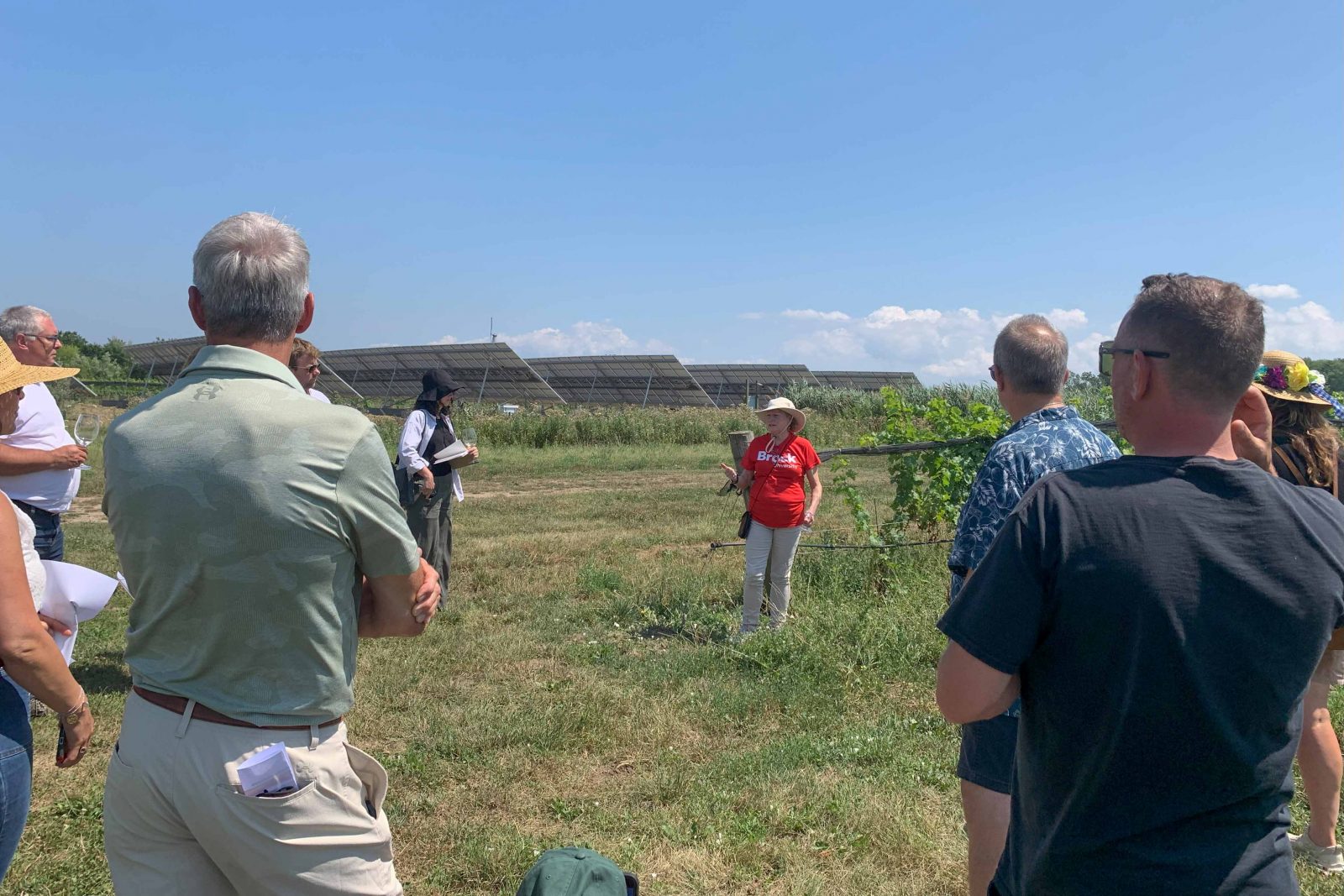
 Brock Professor of Biology Liette Vasseur (centre) explains nature-based climate change adaptation, pest management and soil quality practices to participants attending the “Wine, Native Plants and the Science Behind the Sip: Feet on Farms Tour” event held at Southbrook Vineyards July 27.
 A Brock University-led team is gaining insights into nature-based practices for climate change adaptation, pest management and boosting soil quality through research in three Niagara organic vineyards.
Led by Professor of Biology Liette Vasseur, the group is testing the use of cover crops — primarily flowering indigenous species — to improve resilience to droughts, flooding and other climate change impacts.
These native plants are usually more adapted to local climate and environmental variations than species introduced commercially from outside North America, says Vasseur.
Early results on how seven native species planted last year interreacted with the vineyards are promising.
“Increasing biodiversity through the use of a mix of native species can help to enhance soil health and diversity, buffer against weather extremes, prevent erosion and attract predators of insect pests,” says Vasseur.
The cover crops are also having an impact on the presence of insects.
“Our first observations suggest that leafhoppers are going into the flowers of the cover crops instead of being on the vines, which may reduce damage to the grapes,” says Vasseur.
She says the cover crops are attracting fairy flies and parasitoids, which are among beneficial insects that destroy vineyard pests.
To monitor the types and abundance of insects found in the vineyards, the team is using pieces of coloured cardboard coated with glue that attract and trap insects.
Honours student Angel Lainscek set up yellow, green and red sticky traps in vineyards at the Redstone, Southbrook and Tawse wineries last summer and again this year.
The team has identified three factors – how high the cards are placed, where they’re located along the rows and their colour – that determine the type and number of insects trapped, says Vasseur
“There was a trend towards more leafhopper pest abundance in sections left with only weeds and yellow sticky cards attracted more male than female leafhoppers,” she says.
One of the project’s major partners is the Organic Council of Ontario (OCO), a non-profit organization connecting and representing Ontario’s organic sector.
“As someone who works quite closely with Ontario’s organic producers, I’m endlessly inspired by Dr. Vasseur’s research and her vision for vineyards that work with nature, not against it,” says OCO Public Engagement and Policy Manager Sami McKay.
“By emphasizing biodiversity, building healthy soils, and working toward climate resilience, this research shines a light on an exciting, sustainable, and resilient future for Ontario,” she adds.
The research began last year when the team was awarded funding under the Government of Canada’s Organic Science Cluster 4 (OSC4) initiative for their project “Promoting an integrative landscape approach in vineyards for greater resilience in the face of climatic and environmental changes.”
The OSC4 is co-managed by the Organic Federation of Canada and the Organic Agriculture Centre of Canada at Dalhousie University and is supported by the AgriScience Program under Agriculture and Agri-Food Canada’s Sustainable Canadian Agricultural Partnership.
Included on Vasseur’s team are Associate Professor of Biological Sciences Jim Willwerth, Principal Scientist Sudarsana Poojari with the University’s Cool Climate Oenology and Viticulture Institute (CCOVI) and Biological Sciences and Engineering Assistant Professor Alonso Zavafer.
Willwerth is studying the impacts of cover crops on vine architecture, berry composition and vine health. Poojari is observing the potential presence of viruses, while Zavafer is installing sensors to monitor vine’s physiology.
The research is set to run until 2028.