Master of Education candidate Emily Krushelnycky (BEd '22) is researching how controversial socio-scientific issues are taught in elementary classrooms, especially to students in Grades 1 to 3.
Emily Krushelnycky (BEd ’22) is on a mission to help young learners tackle big questions in hopes of creating a thriving, sustainable future.
The Master of Education candidate is leveraging her elementary classroom teaching experience and passion for science, technology, engineering and mathematics (STEM) education to make a difference through her research.
A graduate of Brock’s Consecutive Teacher Education program, she aims to equip teachers to discuss “loaded” issues with elementary school students.
Krushelnycky’s research explores “socio-scientific” issues, science-based topics that can attract intense debate, and how they’re taught in elementary classrooms, with a particular focus on students in Grades 1 to 3.
“Vaccines, fluoride in water, climate change — if we’re not teaching our students about these important issues, we are not fully preparing them for the future and their lives down the line,” she said.
Krushelnycky found that there is a tendency for primary educators to assume that younger children are not ready to learn about challenging subjects.
“When ‘hot button’ science related issues are not always addressed in the primary grades, we see more apathy amongst older students on these critical topics. There’s a gap in educational research available; I want to use my research to make a difference,” she said.
Her goal is to create a resource for primary educators to help them navigate these issues in the classroom.
“We need to believe in our younger students, but we often avoid issues due to lack of resources about how to have difficult conversations at an early age. I want to create a practical resource for teachers that will help them navigate these big conversations,” she said.
Storytelling, puppeteering and storybooks are ways Krushelnycky said complex ideas can be made more appealing and understanding to a younger audience.
“Kids are so curious by nature, we need to foster that and keep them being creative while developing early critical thinking skills through storytelling and imagination,” she said.
Krushelnycky said that while environmental sustainability is often talked about in the classroom, educators need to go further and question with younger students.
“What are the consequences of not recycling? What are the consequences of new housing developments — what happens to the trees and where do the animals go,” she said.
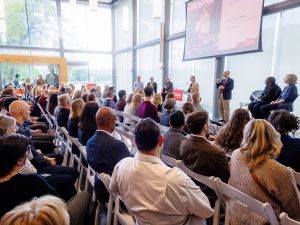
Krushelnycky presented her research earlier this year during the second annual Faculty of Education (FOE) STEM Graduate Student and Research Colloquia organized by Xavier Fazio, Professor of Educational Studies.
Fazio, an expert in science and environmental sustainability education, said opportunities like the colloquia help graduate students get a feel for academic presentations while receiving valuable feedback on their work.
“This year, the event featured research talks from graduate students, FOE Instructors and our post-doctoral fellow,” he said.
Fazio said that innovative practices for Grades K to 12 educators was a common theme for the researchers, whether they were exploring gaming, climate change, science as a “refuge” or using gardens as learning tool in environmental education.
Humanizing STEM education, Fazio said, places issues important to society from a cognitive, social, emotional and environmental perspective at the fore, connecting sciences to our human world.
“Through innovative STEM research addressing human issues, we are reaching out beyond the classroom and into the community with transformative results,” he said.
For Krushelnycky, opportunities like the colloquia have helped to make her Brock graduate student experience second to none.
“The support from faculty has been incredibly valuable. The colloquia showed how excited we are about our research, charging ahead with positivity and passion. It gives me hope for the future of education — we’re going to change the field,” she said.

Professor of Educational Studies Xavier Fazio (far left) organized the second annual Faculty of Education STEM Colloquia this spring. From left are Fazio; Instructor Mariam Takkouch (PhD ’25), who presented “School gardens as a pedagogical tool for environmental education”; PhD candidate Albert Kok, who presented Character education and science education: An exploratory research study”; Post Doctoral Researcher Travis Fuchs, who presented “Heartwarming, heartbreaking, and hopeful: Teachers’ emotions during climate change professional development”; Emily Krushelnycky; and Kristina Salciccioli (PhD ’25), who presented “Success stories in urban science education: Exploring science as refuge.” Grace Babafemi, not pictured, presented “Towards the practicality of game-based learning (GBL) in STEM classrooms: Designing and validating an Instrument to assess teachers’ adoption of GBL.”