Monday, January 26, 2026
attend virtually: LIVESTREAM LINK
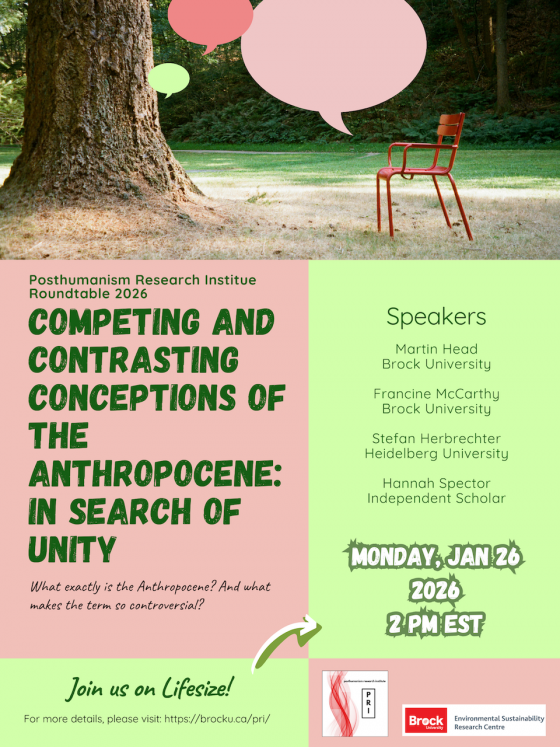
Please join our four speakers — Martin Head and Francine McCarthy (Brock University), Stefan Herbrechter (Heidelberg University), and Hannah Spector (Independent Scholar) — for an exciting Posthumanism Research Institute event!
The term “Anthropocene” was first used in 2000 to denote a new geological epoch that emphasized the central role of humans in geology and ecology. Initially thought to have begun during the Industrial Revolution, subsequent research revealed that the defining changes occurred immediately post-WWII during the Great Acceleration, a term coined by an environmental historian with reference to ‘Hockey Stick’-shaped increases in many key environmental and industrial indicators. The justification for this new epoch in the Geological Time Scale is that we are not merely interacting with our environment but have overwhelmed the natural functioning of our planet. This is an era in which human activities rather than natural processes have come to dominate the planet in categorically — rather than incrementally — distinct ways, bringing about an end to the 11,700 year Holocene Epoch.
Crawford Lake, on the Niagara Escarpment just north of Brock University, has been selected as the candidate reference site to define, physically in the mud of a core recovered from the lake bed, the boundary between the Holocene and the Anthropocene. The point marking this boundary is colloquially known as a “golden spike”. The lake was chosen for research because it is small but deep, which limits circulation and allows annual, even seasonal, deposition of sediments to be recognised – a well-preserved, (sub)annually dated global record of organic material and environmental change. This makes it one of the most useful and unique locations to study the Anthropocene on the planet.
But what exactly is the Anthropocene, and perhaps most controversially, when did it begin?
The Anthropocene Working Group (AWG) established in 2009 by the Subcommission on Quaternary Stratigraphy (SQS) to investigate whether the term “Anthropocene” should be adopted to refer to our current geological epoch. Following 15 years of deliberation, the AWG voted overwhelmingly in support of doing so. Unfortunately the ensuing vote within SQS was fraught with difficulties, but in March 2024 its parent body, the Commission on Stratigraphy, decided against adopting the term. The reasons for doing so were largely ideological, but the evidence base was not challenged, so the AWG will resubmit its proposal when the “political” climate becomes more favourable.
Its potential future adoption concerns not just conceptual clarification and more effective scientific categorization and communication, but may shape decisions regarding further human actions. It’s a meta or self-reflective concept in that sense. The Anthropocene is distinct from prior geological concepts, since it’s future oriented or “anticipatory”; it points to what is to come.
But like flows and currents in the natural world, this word was not easily confined; it has entered popular and academic discourse beyond the natural sciences. Even if not adopted, it may serve as an important and helpful descriptor for understanding our times and our potential future. Even if not adopted, these process are likely to continue unabated, compounded by new and unanticipated processes. Though perhaps the most political fraught and politically important term for any geological era, countless more nebulous terms overlap with it: Capitalocene (economic systems), technocene (human-made systems), Westernocene (neocolonial implications), plantationocene (extraction systems), chthulucene (multispecies entanglements), polycene (plurality of forces).
The emergence of the Anthropocene, even if an unadopted Geological term, indicates the importance of a new Posthuman worldview that emphasizes our entanglements with –rather than separation from –the natural world, prioritizing a conception of the human being that doesn’t seek to master or remake nature.
Regardless of whether the Anthropocene is formally adopted as a geological epoch, the concept reveals a profound shift in how humans understand their place within Earth systems.
There is something categorically unique about our times. We live and move and have our being in a world increasingly of our own making, reflecting ourselves and our activities back to us and obscuring what preceded it and what we have not made. Philosopher Hannah Arendt calls this ‘worldly’ or ‘earthly’ alienation, motivated by a “resentment towards the given”. In other words, the Anthropocene emerged because of certain human values, and impacts the world in which humans live.
Perhaps ultimately the Anthropocene is less a geological designation and more a philosophical wake-up call.
Big questions the panel will explore include:
- Who “owns” the term? What does it refer to? What is gained or lost by its wide usage and adoption beyond the natural sciences? What exactly is controversial about it?
- Should it be restricted to ‘overwhelming human impact’? The adoption of agriculture, the industrial revolution? Dating is complicated.
- What does it mean to be human if the human being is something that brings about these processes – and yet seems less able to contain what it creates or brings into the world? Are any of these trends reversible?
- To what extent did Humanism help to bring about this time period?
- Does the Anthropocene also herald—or even necessitate—the arrival of a new “transhuman” that is better able to live within such an artificial world and contend with its increasingly inhospitable features?
- If there is merit in restricting the Anthropocene to its geological meaning, what other term(s) might be used for the broader human presence on our planet?
Collectively, these questions point to the urgency of rethinking humanity’s role in shaping planetary futures.
Attending Instructions
-
Each of the four speakers will present for 15 minutes (total 1 hour), followed by a 20-minute panel discussion and then an open Q&A.
-
Simply enter your name and join the meeting—no account is required.
-
You may submit your questions in the chat. We will review them and address them during the Q&A session.
Resources
What the Anthropocene’s critics overlook – and why it really should be a new geological epoch
