Refined Question
Using the data, what is the probability of having an accident based
on age?
How does that compare to the cost of insurance for drivers of a certain
age
group?
Data
The information for the probability of having an accident is from
the Fathom document.
I obtained information about the population in Canada by age in order
to
compare it to the rate of accidents by age.
Analysis
Since the male and female insurance costs followed a similar trend
I decided to
focus on the difference age makes in terms of accidents and compare
that to
insurance costs.
When the initial insurance costs were gathered, they
were obtained in two year
intervals. In order to make a fair comparison, I used the accident
rates for the
ages that I had insurance rates for. So, I looked at people between
the ages of
18 and 32 in two year intervals. Using Fathom these are the results
I obtained:
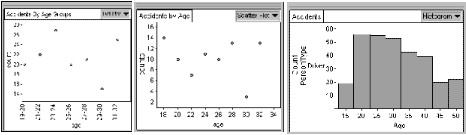

My first hypothesis for the results was that there
may be a higher population for
people of a certain age group. I researched that idea on the Statistics
Canada
web site and found that there is an insignificant difference in the
population
by age groups to account for the difference in accidents by age group.


Next, I compared the rate of accidents
with the cost of insurance. I originally
thought that there would be a similar pattern to these graphs but
I found them
to be different.
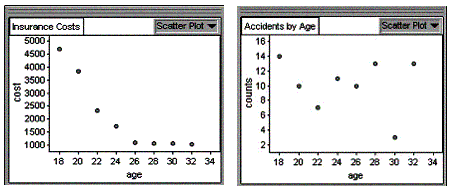
The graph on the left represents insurance
data for both males and females at a
specific age. As was mentioned in the section regarding two-variable
statistics,
there is a non-linear regression. The insurance costs drop drastically
in the first
six years and plateau in the following six years. I expected to see
a similar pattern
in the amount of accidents because I thought that the costs of insurance
would
be based on that information. From the age of 18 to the age of 22
we see a
similar decrease in the points while insurance costs continue to fall
while
accident rates begin to increase. Since we are dealing with Canadian
insurance
costs and American accident rates we can attribute some the discrepancy
to
the inconsistency of data. Also, the sample size for the accident
information is
only 300 compared to the vast number of people that the insurance
companies
insure.
Based on the sample of drivers in accidents that
was taken from the information
on the Fathom CD the probability of being the driver in an accident
that caused a
fatality is as follows:
|
Age
|
Probability
|
|
18
|
0.17
|
|
20
|
0.12
|
|
22
|
0.09
|
|
24
|
0.14
|
|
26
|
0.12
|
|
28
|
0.16
|
|
30
|
0.04
|
|
32
|
0.16
|
|
Between the ages of 18 and 22, the insurance
costs and the accident rates
appear to have a similar trend, but from the ages of 24 to 32 the
insurance
costs decrease while the accident rate increases.
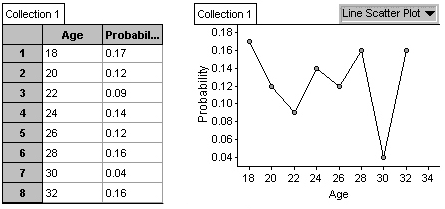
From the probability disbribution we can see that
the probability for getting into
an accident is greater before the age of 25 than after.
Using Fathom I created a graph that displayed the
probability distribution based on a variable, age.
Having found the MTO data I was able
to continue my work on Probability
distributions.
>>
NEXT