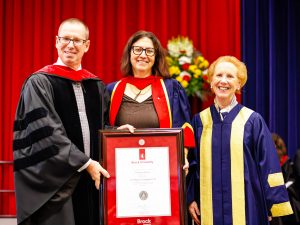
 Psychology PhD graduate Hamnah Shahid (MA ’22, PhD ’26) will take their community-focused research on stigma around illicit drug use to a leading research centre in British Columbia next year after crossing the stage at Brock University’s 120th Convocation on Friday, Oct. 16.
Creating progressive social change has long been a driving force behind Hamnah Shahid’s (MA ’22, PhD ’26) research. Crossing the stage during Brock University’s 120th Convocation on Friday, Oct. 16, brought them a step closer to that goal.
The Psychology graduate’s PhD dissertation, completed under the supervision of Assistant Professor Scott Neufeld, tackled the relationship between drug decriminalization policy development and the stigmatization of people who use illicit drugs.
Before coming to Brock, Shahid completed an undergraduate thesis on substance use and spent two years speaking to people about their experiences with methadone maintenance clinic experiences as a research assistant for Professor Zainab Samaan at St. Joseph’s Healthcare, in partnership with McMaster University.
Neufeld, with his interests in harm reduction and community-engaged research, joined Brock’s Department of Psychology just as Shahid completed a master’s focused on mental health and began searching for a PhD supervisor.
“In my dissertation, I was interested in the systemic level of stigma and how changes in drug policy impact substance use stigma in our legal system, health-care settings and the workplace,” Shahid says. “But the bigger focus was on how changes in drug policy might potentially impact the social or public level of stigma — the ways in which, culturally speaking, we think about and talk about people who use drugs, how we interact with them and how they experience interpersonal interactions.”
Shahid looked at data from an invitation to public comment on a proposed decriminalization policy in Vancouver and also worked with Positive Living Niagara and The Raft to recruit local research participants with lived experiences of substance use to take part in focus groups.
“The comfortable notion that people often rely on is that policing people who use illicit drugs keeps the rest of us safe, but the literature demonstrates that policing people who use drugs actually just causes more harm,” they say. “It doesn’t actually protect the people who are being policed or the rest of the community, either.”
Shahid’s findings on how people talk about policies like decriminalization show that an impulse to control people who use illicit drugs can be found at the heart of policy debates.
“It’s really about this question of whether we should use a system, be it the legal system or a healthcare system, as a means of social control over people who use drugs,” they say. “People, generally speaking, regardless of whether they have lived experience or not, often display varying levels of discomfort with the idea of releasing that control, and that seems to be an obstacle to progressive drug policies and to people being supportive or accepting of such policies.”
Shahid says this response is consistent even among many who express an interest in enacting progressive policies, which is why finding ways to address it will be crucial to harm reduction efforts and policymaking in the future.
“What do we do to help people disentangle their perceived need for that control? And how do we also disentangle the assumption that safety comes from policing people who use drugs?” they say.
In January, Shahid will begin a postdoctoral fellowship at the University of British Columbia, in partnership with the British Columbia Center for Substance Use, where they will be supervised by leading researchers in substance use and harm reduction Professor Thomas Kerr and Associate Professor Jade Boyd.
“I feel very grateful that I get to do the work I do and be let into the vulnerable aspects of people’s lives, that they trust and share that with me,” Shahid says. “And I’m grateful that we are working together in service of hopefully helping to bring about progressive social change in our communities.”