 Brock University Assistant Professor of Political Science Danielle McNabb has co-written a research study exploring how Canadian courts respond when police break the law.
A recent study explores how Canadian courts respond when police officers break the law.
The research, co-led by Brock University Assistant Professor of Political Science Danielle McNabb and University of Guelph Associate Professor of Political Science Kate Puddister, presents the first large-scale empirical analysis of how Canadian courts sentence police officers convicted of breaching the public’s trust.
The study examines the concept of breach of trust, how the Canadian criminal court system responds to police officers as offenders and how sentencing fits within the wider ecosystem of police accountability and oversight.
“Breach of trust, which is a criminal offence in Canada, recognizes there are certain types of officials who are in positions of trust and who hold a lot of power, so we expect these individuals to be held to a higher standard and held to account when they abuse the authority society has granted them,” McNabb says.
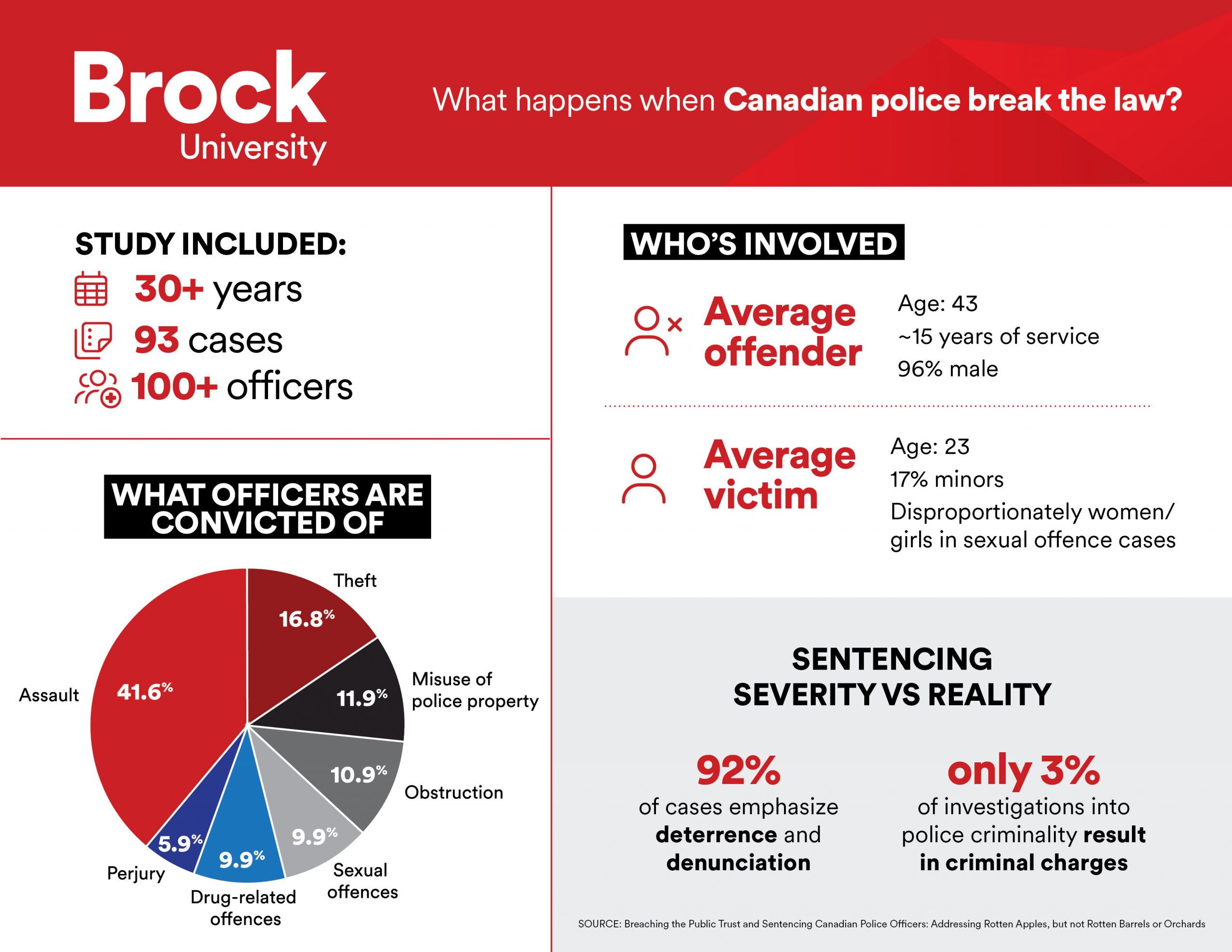
Drawing on 93 sentencing decisions involving more than 100 officers between 1990 and 2024, the study finds that judges consistently treat police criminality seriously — emphasizing denunciation and deterrence in 92 per cent of cases — yet the researchers argue this individualized approach can’t address the deeper, systemic drivers of police misconduct.
The authors are calling for two concrete reforms. The first is a Criminal Code amendment creating a specific aggravating factor for offences committed by police officers, formalizing what courts already do informally and ensuring consistent treatment across jurisdictions.
In criminal law, aggravating factors require judges to consider imposing a harsher sentence where certain circumstances are present. For instance, in Canada, if a crime was motivated by hate or involved intimate partner violence, judges must consider imposing a serious sanction.
McNabb says police criminality poses a similar, important problem for society. Therefore, an officer-specific aggravating factor would require judges — in all criminal cases involving a police officer offender — to consider imposing a serious sentence.
“This would encourage courts to consider the wider, systemic and institutional context of police criminality. It would also help to ensure that sentences are always aimed at repairing the public trust that is diminished when police officers commit crime,” McNabb says.
The second reform is greater public transparency around case outcomes — from investigation through sentencing — so both the public and police themselves can evaluate how accountability actually functions.
The researchers caution these reforms are partial fixes. Sentencing an individual officer, however severely, cannot touch departmental culture, the “blue wall of silence” or the disproportionate rates of police violence experienced by Black, Indigenous and other racialized communities. As the authors put it: courts can address the rotten apples, but not the rotten barrels or orchards.
The study includes a wealth of information about police criminality, including:
- The top three offences committed by officers were assault, theft and misuse of police property, with the most common form of misuse being accessing police databases for stalking victims or other crimes.
- Approximately 84 per cent of offences were committed by on-duty officers.
- The most frequent sentences were probation (48 per cent of the cases), incarceration for less than two years (26.7 per cent) and a conditional discharge or conditional sentence order (both at 18.8 per cent).
These and other findings are detailed in the study, “Breaching the Public Trust and Sentencing Canadian Police Officers: Addressing Rotten Apples, but not Rotten Barrels or Orchards,” published in the journal Police Quarterly.
Brock University Assistant Professor of Political Science Danielle McNabb has co-written a research study exploring how Canadian courts respond when police break the law.