 The International Astronomical Union’s Working Group Small Bodies Nomenclature has named an asteroid after Brock University Professor of Earth Sciences Mariek Schmidt.
Look up. With any luck, and a telescope, the asteroid Mariekschmidt may drift into view.
“It’s cool,” says its namesake Mariek Schmidt. “In planetary science and astronomy, it’s a relatively common recognition. But for people outside of the discipline, it’s cool to have an asteroid named after you.”
The Brock Professor of Earth Sciences first found out about the recognition through Tim McCoy, Curator of Meteorites at the Smithsonian Institution’s National Museum of Natural History and Schmidt’s postdoctoral studies supervisor at the Institution.
McCoy nominated Schmidt to receive the honour of having a minor planet, which is an asteroid and other fragment dating back to the birth of the solar system, named after her.
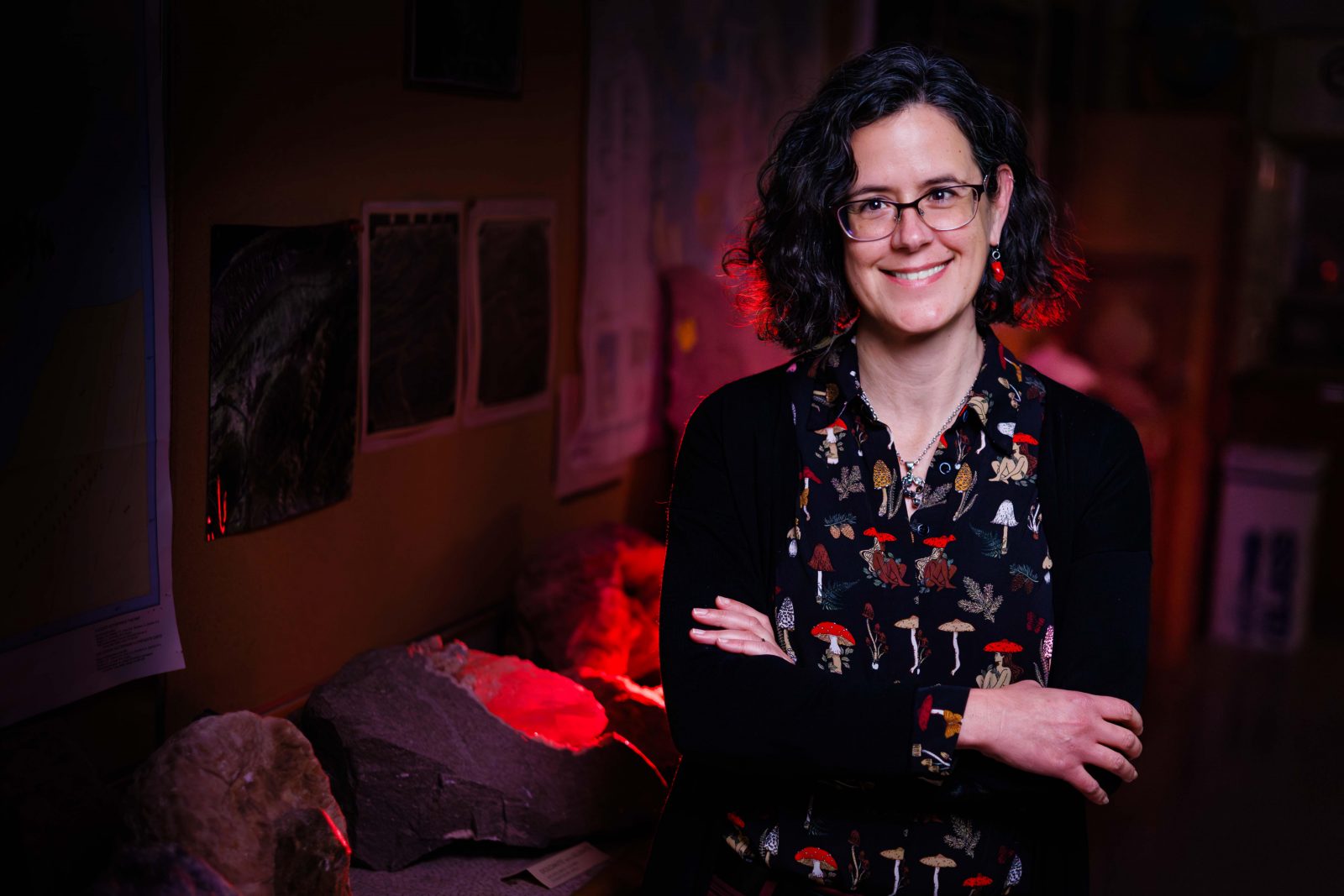
Brock University Professor of Earth Sciences Mariek Schmidt
Scientists study these objects to get an idea of the environments in which planets were formed and the chemicals that were present in Earth’s early history.
“I was blown away by Dr. McCoy’s thoughtfulness and reached out to thank him,” Schmidt says. “He also nominated a number of people who I worked with when I was at the Smithsonian, so it was just nice to see other people’s names pop up on the list.”
Measuring about two kilometres by five kms, the Mariekschmidt asteroid orbits the sun within the main belt between Mars and Jupiter. It was discovered in 1981.
Members of the International Astronomical Union’s Working Group Small Bodies Nomenclature (WGSBN) assign names to minor planets, comets and satellites of minor planets. The Mariekschmidt asteroid is recorded in the Aug. 17 edition of the WGSBN Bulletin.
The bulletin entry cites Schmidt’s research on volcanic rocks in the Oregon Cascade Range as well as her work on various Mars rover missions and examination of volcanic activity in Mars’ ancient past.
Schmidt’s research on the Red Planet dates back to 2005, when the Smithsonian Institution hired her to be a Postdoctoral Collaborator on the Mars Exploration Rover mission working with data from both the Spirit and Opportunity rovers.
Soon after joining Brock in 2009, she set up a research program investigating the eruptive and environmental histories of volcanic fields on Earth and Mars.
In 2012, NASA selected Schmidt to be a Participating Scientist on the Mars Science Laboratory mission, working with the Curiosity rover, a project that is ongoing.
And in late 2020, she became a Participating Scientist on the Mars 2020 rover mission, analyzing data from NASA’s Perseverance rover. In 2025, she was named Co-Investigator on the Planetary Instrument for X-ray Lithochemistry (PIXL).
Schmidt has published a number of studies, including magmatic history of rocks on Mars and potential signs of ancient life on the planet.