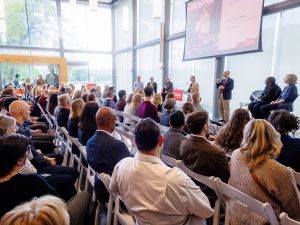
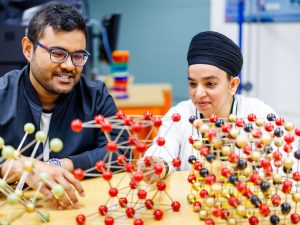
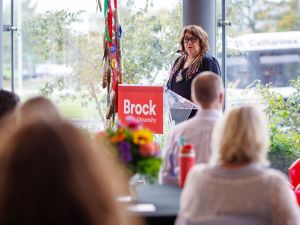
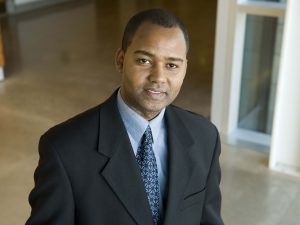
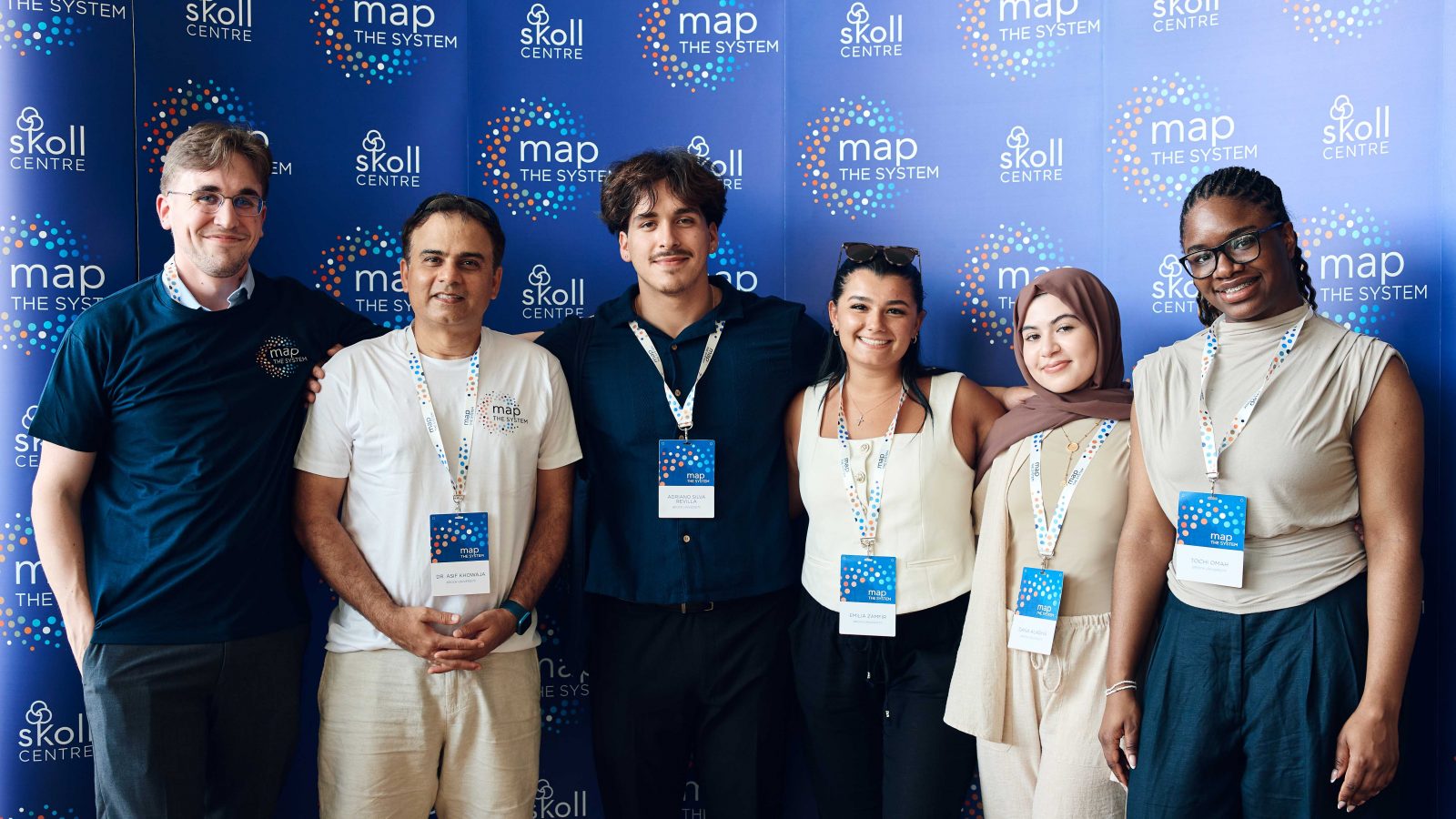
 Brock's first-ever Map the System team traveled to Oxford University in the United Kingdom to compete in the global competition earlier this month. From left are students Computer Science master’s student Tyler McDonald (BSc '25), Associate Professor of Health Sciences Asif Khowaja, undergraduate Medical Sciences student Adriano Silva Revilla, Business Economics master’s student Emilia Zamfir (BA '25), and Applied Health Sciences master’s students Dana Alagha (BSc '23) and Tochi Omah (BSc '25).
For Brock University’s first Map the System team, competing in the international competition at Oxford University was about more than presenting research on a global stage — it reshaped the way they think about research itself.
Map the System is just one example of how collaboration between Brock’s Faculty of Graduate Studies and Postdoctoral Affairs (FGSPA) and the Office of the Vice-President, Research is creating opportunities for students to work across disciplines, strengthen their skills as emerging researchers, participate in knowledge mobilization and create meaningful solutions to complex global challenges.
“This experience reflects key intersections between graduate studies and research,” said Vice-President, Research Tim Kenyon. “Opportunities like Map the System empower our students to be collaborative, engaged and globally minded researchers who make a difference within and beyond the University.”
Members of Brock’s interdisciplinary Map the System team included Business Economics master’s student Emilia Zamfir (BA ’25), Applied Health Sciences master’s students Tochi Omah (BSc ’25) and Dana Alagha (BSc ’23), Computer Science master’s student Tyler McDonald (BSc ’25) and undergraduate Medical Sciences student Adriano Silva Revilla.
Their research project explored the how social, technological, economic and health factors interact to shape outcomes of social media overuse among adolescents in Canada.
Participating in Map the System has fundamentally changed the way Zamfir approaches research.
“This experience taught me to ask broader questions, challenge my own assumptions and think about how different systems interact with one another,” she said. “Presenting our work at Oxford and learning alongside teams from around the world reinforced that some of the best ideas come from collaboration, curiosity and a willingness to learn from people whose backgrounds are very different from your own.”
Her teammates shared a similar experience.
Working alongside students from diverse academic backgrounds encouraged Silva Revilla to move beyond testing hypotheses and to begin viewing research through a systems lens.
“It allowed our research topic to be seen through various lenses that we wouldn’t have thought of right away,” he said. “That’s the beautiful part of having such diverse minds.”
The collaborative environment also reinforced for the team that tackling complex challenges often requires more than expertise in a single field.
“Our varied academic backgrounds allowed us to explore how deeply interconnected and complex the consequences of social media overuse can be,” said Omah. “Meaningful insights emerge when different perspectives are brought together.”
Alagha said the experience expanded the way she thinks about the broader impacts of research.
With a background in health economics and health sciences, she said she typically focused on health-care outcomes and economic implications. Through the project, however, she began considering how issues intersect with policy, sustainability, human capital and other interconnected systems.
“Collaborating with my team enabled me to look at our topic through a systems perspective,” she said. “It facilitated the pursuit of meaningful and sustainable solutions while exploring existing gaps and potential further actions.”