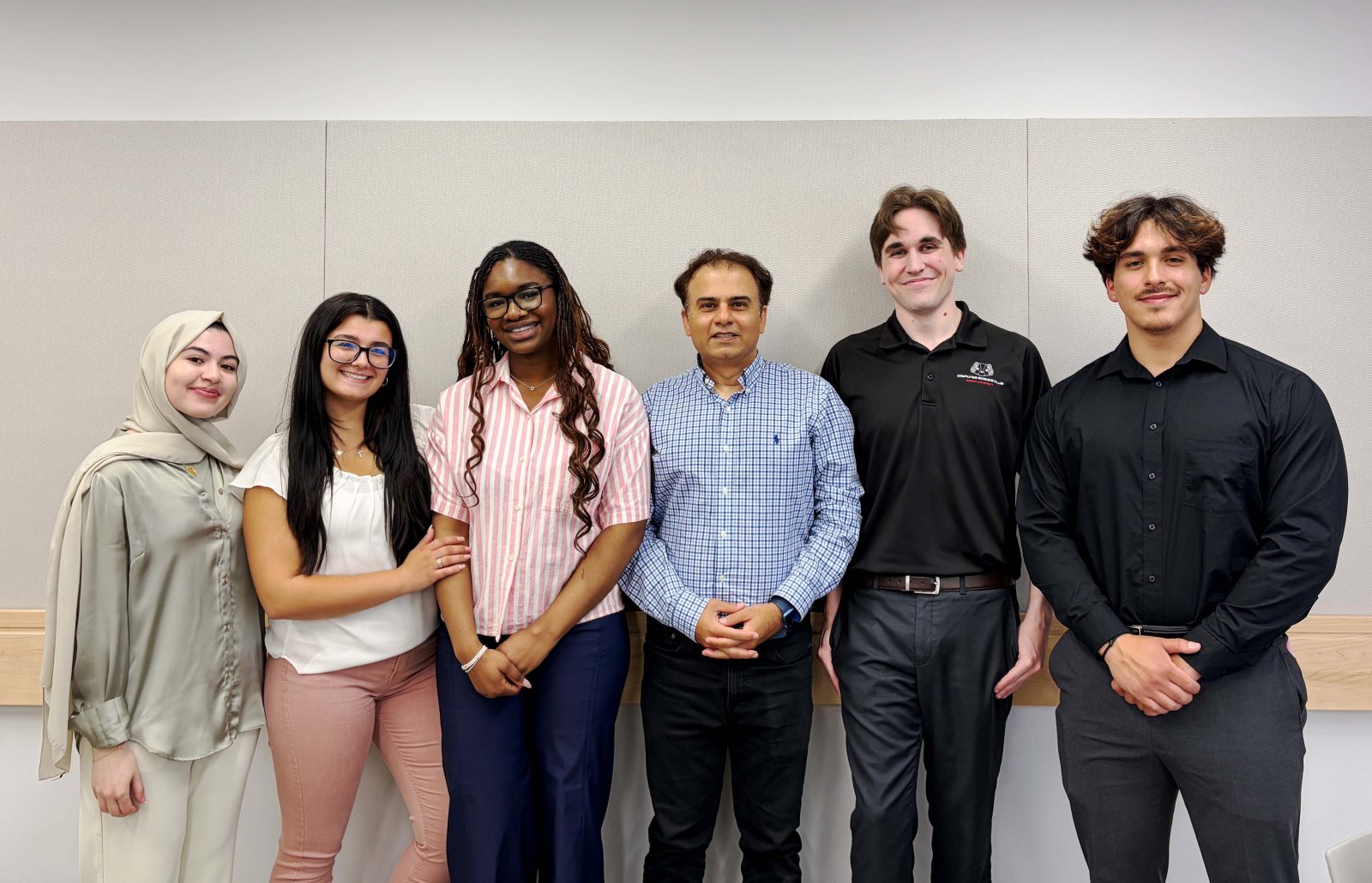
 Brock's first-ever Map the System team will compete at the global event at the University of Oxford later this week. From left are students Dana Alagha, Emilia Zamfir and Tochi Omah, Associate Professor Asif Khowaja and students Tyler McDonald and Adriano Silva Revilla.
A team of Brock University students will bring their knowledge of social media’s impact on youth to the international stage this week, competing at University of Oxford’s Map the System.
Hosted from July 9 to 12 by the Skoll Centre for Social Entrepreneurship at Oxford University’s Saïd Business School, Map the System challenges students to examine the root causes of complex social and environmental issues through systems thinking. Rather than focusing on solutions alone, participants are encouraged to explore the interconnected relationships, structures and perspectives that contribute to society’s most pressing challenges.
Brock’s team — the first in the University’s history to compete at the global event — will present their project, The Unintended Consequences of Social Media Overuse Among Adolescents: Health, Educational, Economic, Environmental and Policy Implications in Canada. The collaborative effort by students Emilia Zamfir, Tochi Omah, Tyler McDonald, Dana Alagha and Adriano Silva Revilla explores how social media platforms influence the well-being of young Canadians through a complex web of technological, social, economic and policy factors.
Associate Professor of Health Sciences Asif Khowaja, the team’s faculty advisor, helped guide the students’ systems-thinking approach and prepare them for the international competition.
The team investigated the growing impacts of adolescent social media use, from rising mental health concerns and educational outcomes to economic costs, environmental impacts and policy challenges.
“We are incredibly proud of Dr. Asif Khowaja and his team for becoming the first group to represent Brock at this prestigious international competition,” said Philip Sullivan, Associate Dean, Student Success, Faculty of Graduate Studies and Postdoctoral Affairs, and Professor of Kinesiology.
“As a computer scientist, Map the System has taught me so much about learning from every perspective,” said McDonald. “A lot of my interests include the issues of ethics, fair use and bias that naturally arise when we use the internet and AI so regularly, but being able to look at that problem from the lens of health care, the environment, regulation and the economy has reinvigorated my interest in creating safe digital spaces.”
Through a six-week program held in advance of the competition, the team completed a series of guided learning modules that helped them build a comprehensive systems map of their research topic. Rather than focusing on a single solution, the process challenged students to identify the interconnected factors contributing to adolescent social media overuse and examine how those relationships evolve over time.
Central to the project is the team’s Screenberg Model, a framework that illustrates the interconnected factors driving adolescent social media overuse.
The model explores issues such as body image, social comparison, fear of missing out (FOMO) and the effects of constant exposure to short-form content, while also examining the influence of algorithm-driven platforms and the mental models that shape user behaviour.
Beyond strengthening their research skills, the experience highlighted the value of interdisciplinary collaboration.
“The team comes from so many diverse backgrounds, and that’s not something we always get the pleasure of seeing when we’re doing field-specific research,” McDonald said. “Collaborating with so many different Faculties and fields has given me a whole new perspective on how I can impact the world as a researcher and voice for change.”
Representing Brock at the global competition marks an important milestone for the University and reflects its growing commitment to experiential learning, interdisciplinary collaboration and research that addresses complex societal challenges.
For McDonald, the opportunity extends beyond presenting the team’s research.
“Bringing this project to Oxford isn’t just a great time to showcase our interests to the world, but it’s also a chance to have people associate the Brock name with passionate, motivated and excited students who really care so deeply about their work,” he said. “To be even a small part of that journey has been amazing for me.”