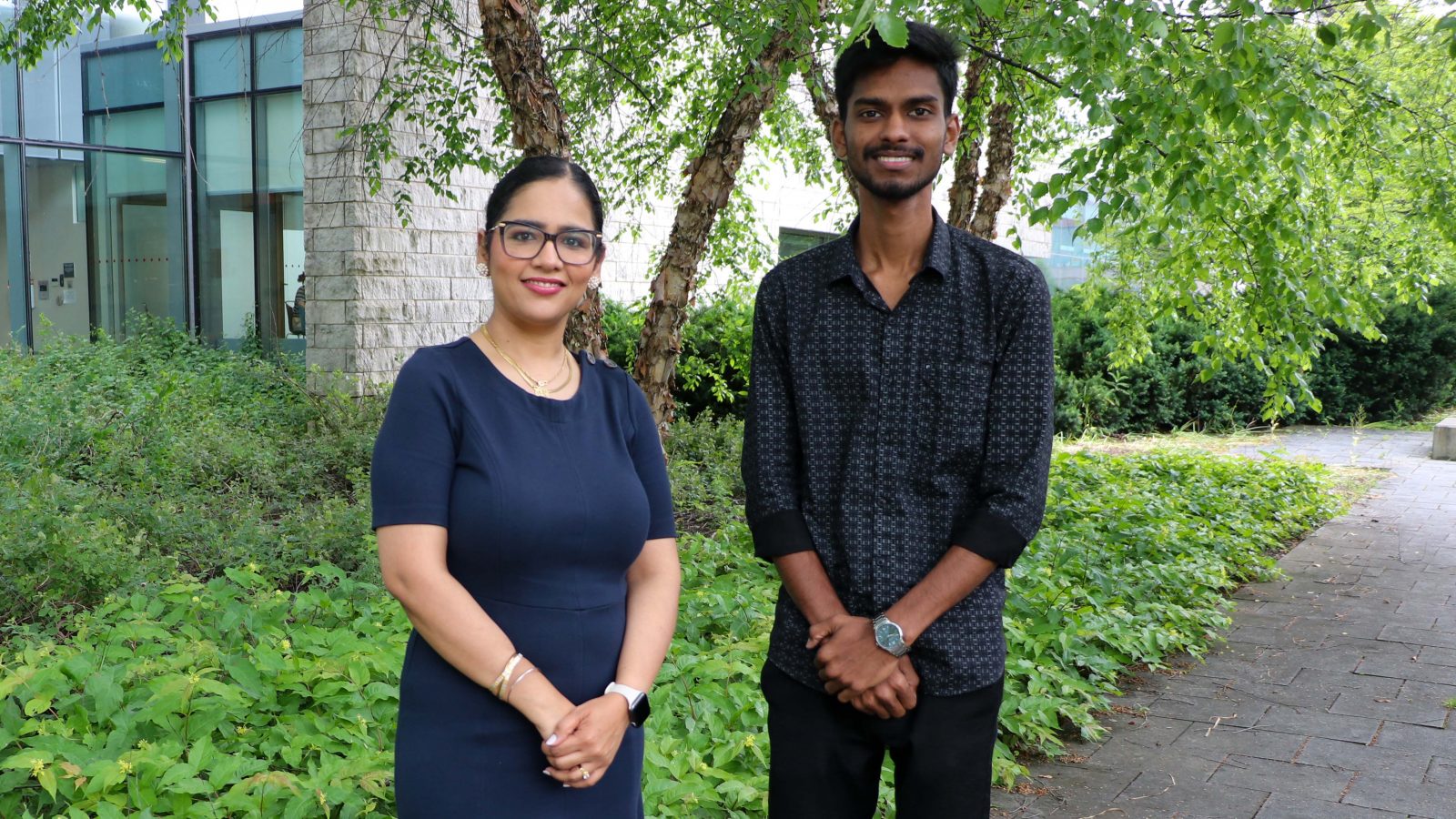
 Associate Professor of Chemistry Divya Matta Kaur (left) and Chemistry PhD student Subrat Sethy (right) have recently published research on how proteins help transport electrons after light is captured during photosynthesis, a finding that could have applications in agriculture.
 Divya Matta Kaur is looking to a single-celled organism — commonly seen in blue-green algal blooms — for ways to help crops harness the sun’s energy more efficiently.
Her lab’s latest work builds on their previous research examining the process of photosynthesis in cyanobacteria.
Photosynthesis occurs when plants convert sunlight into chemical energy. The sun’s rays emit various intensities of radiation mapped out by colour on the solar spectrum. Far-red light, barely visible to the human eye, is lower in energy than wavelengths of light most plants use efficiently.
In their earlier work, however, the Associate Professor of Chemistry and her international research team showed some cyanobacteria have created methods to capture and convert far-red light into chemical energy.
In two recently published papers, the researchers examined how cyanobacteria adjust their photosynthetic systems under challenging light conditions and how energy flow is preserved after light is captured.
In a research paper published May 18 in the journal Plants, Matta Kaur and researchers at Vignan’s Foundation for Science, Technology and Research in India studied gene-level responses in Acaryochloris marina, a cyanobacterium known for living in far-red light environments.
The researchers found that Acaryochloris marina’s response is not controlled by one part of the cell alone. Instead, genes and proteins involved in photosynthesis appear to adjust together.
“This is significant because it shows that photosynthetic adaptation is not controlled by a single switch,” says Matta Kaur. “The organism adjusts multiple parts of the photosynthetic system together, giving us a more complete picture of how life responds to challenging light environments.”
In the second paper published June 16 in The Journal of Physical Chemistry B, a journal of the American Chemical Society, the team studied groups of proteins — called Photosystem I — that help transport electrons after light is captured during photosynthesis.
“This pathway shapes how energy moves at the molecular level,” says Chemistry PhD student Subrat Sethy, the study’s lead author. “We wanted to understand how the surrounding protein environment influences that pathway under different light conditions.”
Using computational chemistry methods, the researchers looked at how the local protein environment shapes the energy landscape around the iron-sulfur clusters, small metal-containing centres that play a key role in moving electrons through Photosystem I.
Sethy says the calculations showed the basic electron-transfer framework remains the same under visible and far-red light conditions, but the surrounding protein environment can shift in subtle ways, effectively fine-tuning how electrons move through the system.
“That is scientifically exciting because it shows a principle of biological design,” says Sethy. “The system does not need to rebuild the entire pathway. Instead, it can preserve the core structure while fine-tuning the local environment around it, helping electrons move efficiently under different light conditions.”
Matta Kaur says the two studies give a more detailed picture about how genes and electrons help cyanobacteria carry out photosynthesis in challenging light conditions “with extraordinary precision.”
“For future crop and bioenergy research, the lesson is not that we can simply copy one cyanobacterium into a crop to increase the crop’s efficiency in photosynthesis,” she says.
“The real value is learning nature’s design principles: how organisms capture difficult light, maintain efficient electron transfer and remain functional in changing environments.”
With that knowledge, she says the long-term goal is to inform more resilient strategies that make better use of light and energy in agriculture, biotechnology and clean energy.
Funding this research is the Government of Canada’s Natural Sciences and Engineering Research Council.