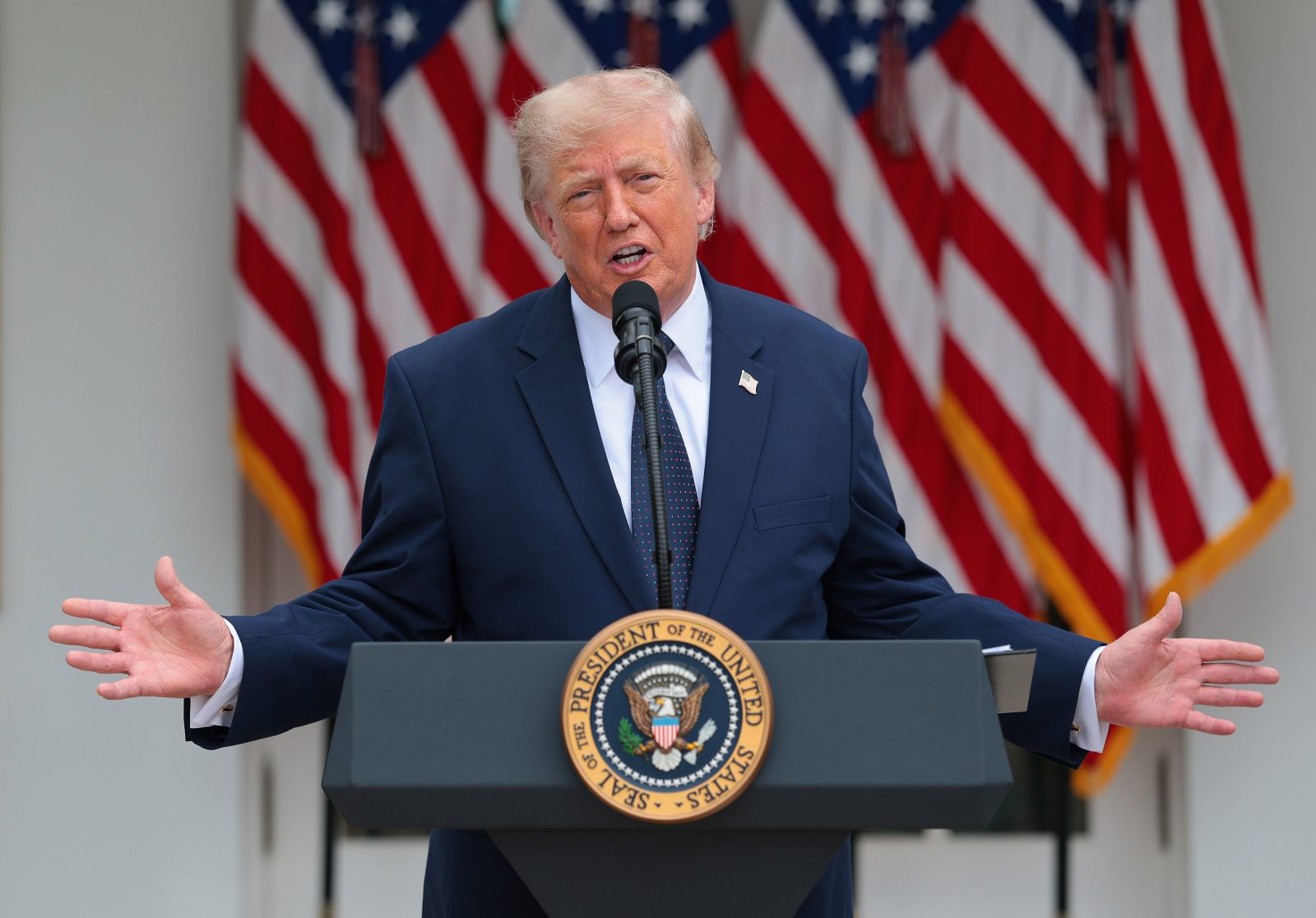
 Taylor McKee, Assistant Professor of Sport Management at Brock University, recently published a piece in The Conversation about Trump's recent call to FIFA President Gianni Infantino to ask that a red card issued to American player Folarin Balogun be reconsidered. (Photo by Anna Moneymaker/Getty Images)
This piece written by Taylor McKee, Assistant Professor of Sport Management at Brock University, originally appeared in The Conversation.
“All I did was ask for a review because I didn’t think it was a foul,” United States President Donald Trump said this week in front of reporters in the Oval Office. He was explaining why he had personally called FIFA President Gianni Infantino to ask that a red card issued to American forward Folarin Balogun be reconsidered.
Balogun had been issued the red card during the team’s round of 32 match against Bosnia and Herzegovina on July 1. The Americans won that match 2-0, but a red card normally carries an automatic one-match suspension.
Four days later, FIFA announced it had placed Balogun on one year’s probation instead, citing Article 27 of its disciplinary code, which gives FIFA’s judicial bodies discretion to hold off on enforcing sanctions. FIFA also fined U.S. Soccer US$40,000, and the red card stayed on Balogun’s record.
Infantino confirmed he had spoken with Trump, but said he told the president the matter was subject to “an ongoing legal process involving FIFA’s independent judicial bodies.” Trump, for his part, said he did not tell Infantino what to do.
The reversal allowed Balogun to play against Belgium in the round of 16 match. Belgium defeated the U.S. 4-1, and Balogun and his team bowed out of the World Cup at the same stage as they did in 1994, 2010, 2014 and 2022.
The controversy is a small but revealing example of a much larger debate about the perceived rules-based international order.
FIFA’s own rules allowed the exception
FIFA’s competition regulations state plainly that a red card triggers an automatic suspension for a team’s next match. Yet after the call from Trump, FIFA suspended enforcement of that sanction for Balogun.
The Royal Belgian Football Association tried and failed to appeal the decision, and the Union of European Football Associations, European soccer’s governing body, said FIFA had “crossed a red line.”
FIFA maintains a broader non-interference principle, which is meant to shield national federations and disciplinary decisions from outside political pressure.
Legal experts Lesedi Mphahlele and Sello Ramanyana, writing for South Africa’s Fairbridges Attorneys, note that FIFA has suspended entire member federations in the past for allowing government interference in football matters. But when the call comes from inside the White House, the rules appear more flexible.
It wouldn’t be the first time political pressure has shaped a FIFA disciplinary outcome. In 1962, Brazil’s prime minister sent FIFA a telegram appealing a suspension on forward Mané Garrincha, arguing he shouldn’t be penalized; FIFA lifted the ban in time for Garrincha to play in the final.
What procedure obscures
FIFA said Article 27 allowed it to suspend the punishment. But sports organizations often lean on procedural language exactly when a decision also raises questions about power. The public is asked to treat the outcome as technical and routine, and to set aside the unusual path by which the case arrived there.
Infantino has said he regularly speaks with heads of state, government officials and football stakeholders about matters related to the tournament, and has defended maintaining close contact with the leaders of host nations as part of the job.
Infantino’s framing is easiest to maintain because the U.S. lost. Had the American team won, questions would have ensued about whether Balogun’s presence on the field had unfairly tipped the match in the Americans’ favour, and whether Belgium had been cheated out of a win.
Those questions would have kept the pressure on FIFA’s decision, because the outcome itself would have been in doubt. The 4-1 loss removed that pressure. Balogun played, and the U.S. lost regardless, so there was no tainted result left to argue about.
The limits of the rules-based order
Then-President Joe Biden warned in 2022, after Russia’s invasion of Ukraine, that the international rules-based order was in jeopardy. The Balogun case is a smaller test of the same idea.
Rules, whether they govern trade, international diplomacy or sport, work by binding everyone the same way, regardless of standing. They discipline players, structure competitions and produce the language of fairness.
Legal scholars argue the assumption doesn’t hold evenly. The British Institute of International and Comparative Law asks directly whether the rules-based order contains “rule-makers and rule-takers,” and warns that governments can use the language of rules selectively as political circumstances change.
Law professor John Dugard goes even further by connecting this to American practices, arguing that the rules-based order can become a broad and politically malleable alternative to international law, especially when the U.S. wants language flexible enough to accommodate its own interests.
So what are we left with? Powerful entities will attempt to force regulators stretch, bend and broadly interpret rule-sets, and will no doubt do so more often in the future, knowing that as long as the right leverage is applied, outcomes are not fixed.
In the world of international soccer, permitting this type of intervention is not a slippery slope, it is a steep cliff. Sport is inherently rife with controversy and, often times, injustice.
Equally intrinsic to sport is the acceptance of unexpected factors like injuries, adverse weather, and bad calls. But a self-absorbed worldview makes it difficult to see the significance of these external realities, since the costs borne by others remain entirely on the periphery.
As the Balogun decision revealed, the rules might discipline ordinary participants and structure the language of fairness. But as a single phone call from the Oval Office to FIFA headquarters showed, they do not always constrain those with sufficient power to reshape their meaning.