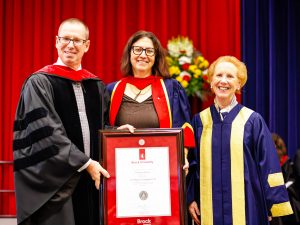
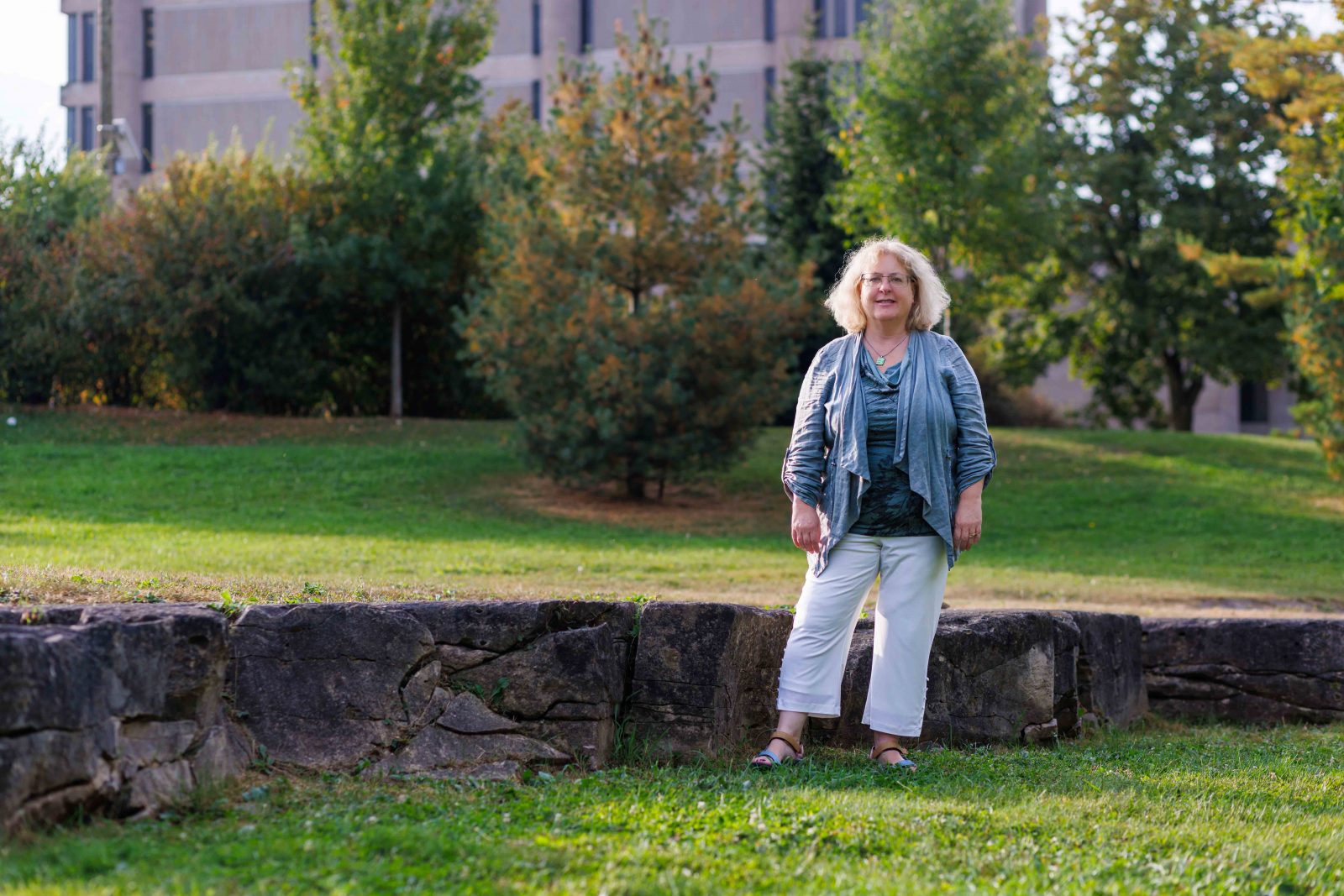
 Professor of Earth Sciences Francine McCarthy received the 2026 W.A. Johnston Medal from the Canadian Quaternary Association in recognition of her outstanding professional achievement in the field of Quaternary science.
 Professor Francine McCarthy has spent her career digging into the mysteries of Earth’s history.
The renowned micropaleontologist has received the Canadian Quaternary Association’s (CANQUA) 2026 W.A. Johnston Medal for her outstanding professional achievements in Quaternary science, which explores a geological period stretching from 2.6 million years ago to the present day.
“What attracted me to Quaternary science was that it is at the intersection of natural sciences and social sciences,” she said. “It’s at the intersection of biological and the physical natural sciences.”
McCarthy’s contributions to the field include research advances in proxy-based Quaternary reconstructions, leadership in promoting Crawford Lake as an internationally significant geological archive and candidate as a proposed geological market for the Anthropocene, and extensive mentorship and service.
While Crawford Lake brought international attention to her research, McCarthy says the award also recognizes decades of scientific contribution to Canada and beyond.
“CANQUA mentioned, of course, the work that I’ve done on Crawford Lake to establish a golden spike for the Anthropocene, but also my long, many decades of research before I took on the work at Crawford Lake,” she said.
Located in Milton, Ont., Crawford Lake gained international prominence through research examining sediment layers that provide an unusually detailed record of environmental change.
McCarthy has played a leading role in investigating whether humanity’s influence was significant enough to mark the beginning of a new geological epoch known as the Anthropocene. She continues to study the site’s scientific significance and its implications for understanding planetary change.
Beyond recognition, she views the award as motivation to continue addressing some of the most pressing environmental questions facing society.
“More than ever,” she said. “The challenges that humanity and the planet face really need Earth scientists.”
The interdisciplinary nature of Quaternary science, drawing from biology, geography and environmental science, as well as the social sciences, has led McCarthy to work with colleagues across campus and researchers around the world.
Recently, her interests have expanded to examine how societies respond to environmental change and how scientific knowledge can inform decision-making.
The award also highlights Brock’s outstanding contributions to Quaternary science.
Jaan Terasmae, the University’s first geology professor and a founding member of what is now known as the Department of Earth Sciences, received the 2026 W.A. Johnston Medal in 1990.
“Brock has always been renowned in Canada for Quaternary science,” McCarthy said. “Brock throughout its existence had strength in Quaternary science that was recognized externally by people across Canada.”
That legacy has helped shape generations of students. McCarthy notes many Brock graduates have gone on to senior roles with organizations such as the Ontario Geological Survey, the Geological Survey of Canada and environmental consulting firms.
“Students who studied here have been exposed to high-quality Quaternary science,” she said.
Mentorship is a key focus for McCarthy and she sees helping students transition from the classroom to the scientific community as one of the most rewarding aspects of her work, whether through research projects, conferences or collaborative opportunities.
“My philosophy is that each student is different,” she said. “I fan the flame of curiosity, encouraging their interests and strengths.”