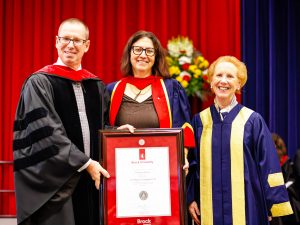
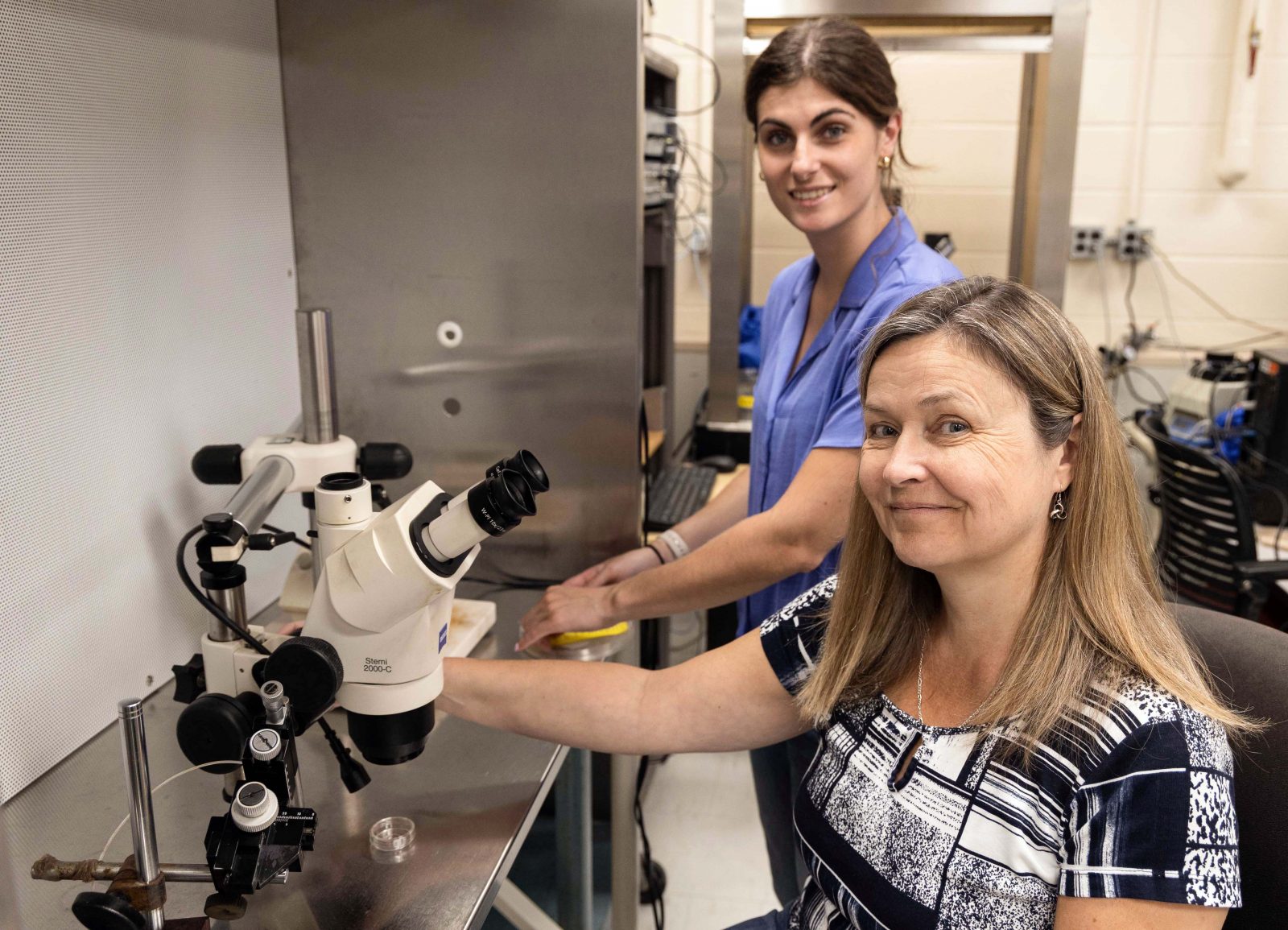
 Professor of Biological Sciences Gaynor Spencer (right) and her research team, which includes Biological Sciences PhD student Alicia Piazza (left), have received one of eight Discovery Grants awarded to Brock University researchers by the Government of Canada’s Natural Sciences and Engineering Research Council this year.
 Retinoic acid may be a small molecule, but it has mighty impacts.
Essential for brain and nervous system development, the product of Vitamin A usually works by changing the expression of genes. What intrigues Brock University researcher Gaynor Spencer, however, is its ability to induce rapid changes to cells through lesser understood “non-genomic” processes.
“These non-genomic effects of retinoic acid are important for directing nerve outgrowth and controlling communication between neurons in the brain,” says the Professor of Biological Sciences.
Spencer and her team are researching the topic with funding from the Government of Canada’s Natural Sciences and Engineering Research Council (NSERC).
She is among 10 Brock researchers who have received a total of more than $2.4 million in 2026 NSERC Discovery Grants and Research Tools and Instruments grants, announced Tuesday, July 7.
“Creativity and innovation drive the research that improves lives and strengthens communities in Canada and around the world,” says Chris Bittle, Member of Parliament for St. Catharines. “Through the Discovery Grants Program, our government is proud to support Brock University researchers whose groundbreaking work is helping shape a stronger future.”
Since joining Brock more than 25 years ago, Spencer has been studying how retinoic acid is involved in regenerating neurites — an outgrowth of a brain cell much like branches from a tree trunk — through processes other than changes in gene expression.
She and her team, including Biological Sciences PhD student Alicia Piazza, have shown that retinoic acid plays a role in the movement of growth cones, structures that guide neurites to other neurons like a GPS signal.
In this latest research, the team will take a closer look at how retinoic acid guides neurite outgrowth as well as how disrupting retinoic acid signalling might affect the operations of neuronal circuits within the brain. By examining how retinoic acid also affects circuits, they can understand how it is involved in memory processing, Spencer says.
“Studying retinoic acid’s non-genomic effects give us some insight into how the connections between neurons are changing and how these changes affect learning and memory,” she says.
Vice-President, Research Tim Kenyon says insights from this work and the other projects receiving support are examples of the many ways Brock research makes a difference in Canada and beyond.
“Health, the environment and technology development are among major areas of concern,” he says. “The breadth and depth of these projects yield greater knowledge that we share beyond the University.”
Brock’s 2026 NSERC Discovery Grants recipients include:
- Assistant Professor of Physics Gavin Hester (Faculty of Mathematics and Science) — “Amorphous Magnetic Materials for Quantum Technologies and Magnetocaloric Cooling”
- Professor of Biological Sciences Fiona Hunter (Faculty of Mathematics and Science) — “Biting flies and other insects: changing distributions, arboviruses and behaviours”
- Associate Professor of Health Sciences Rebecca MacPherson (Faculty of Applied Health Sciences) — “Characterizing regulatory pathways for amyloid precursor protein processing”
- Assistant Professor of Computer Science Blessing Ogbuokiri (Faculty of Mathematics and Science) — “Beyond Demographics: Provably Fair and Scalable Contrastive Representation Learning”
- Professor of Engineering Shahryar Rahnamayan (Faculty of Mathematics and Science) — “Sustainable AI for People and Planet: Gradient-Free Multi-Objective Optimization for Compact, Fair, and Efficient Deployment”
- Professor of Biological Sciences Gaynor Spencer (Faculty of Mathematics and Science) — “Understanding the role of retinoids and their receptors in nervous system functions”
- Professor of Biological Sciences Glen Tattersall (Faculty of Mathematics and Science) — “Shifting Set-Points: Integrative Mechanisms of Behavioural and Physiological Thermoregulation”
- Professor of Chemistry Tony Yan (Faculty of Mathematics and Science) — “Chemical modification, structural and functional study of nucleic acids”
Brock’s 2026 NSERC Discovery Development Grant recipients include:
- Associate Professor of Computer Science Renata Dividino (Faculty of Mathematics and Science) — “Trustworthy Graph Neural Networks: Privacy Preservation and Adversarial Robustness”
- Professor of Mathematics Omar Kihel (Faculty of Mathematics and Science) — “On Certain Diophantine Equations and the Rank of Elliptic Curves”
- Associate Professor of Mathematics and Statistics William Marshall (Faculty of Mathematics and Science) — “Integrated Information – Estimation and Application”
Brock’s 2026 NSERC Research Tools and Instruments grant recipients include:
- Professor of Biological Sciences Fiona Hunter (Faculty of Mathematics and Science) — “Keyence digital photomicroscope for insect taxonomy to replace obsolete film-based photomicroscope”
- Associate Professor of Engineering Moshin Jamil (Faculty of Mathematics and Science) — “Real-Time Simulation and Optimization Platform for Advanced Power Electronics and Clean Energy Systems”
- Assistant Professor of Biological Sciences Alonso Zavafer (Faculty of Mathematics and Science) — “Fourier Transform Raman Microspectrometer to Enable Advanced and High-Throughput Characterization of Biological and Functional Materials”