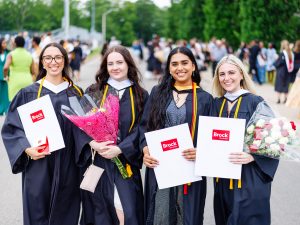
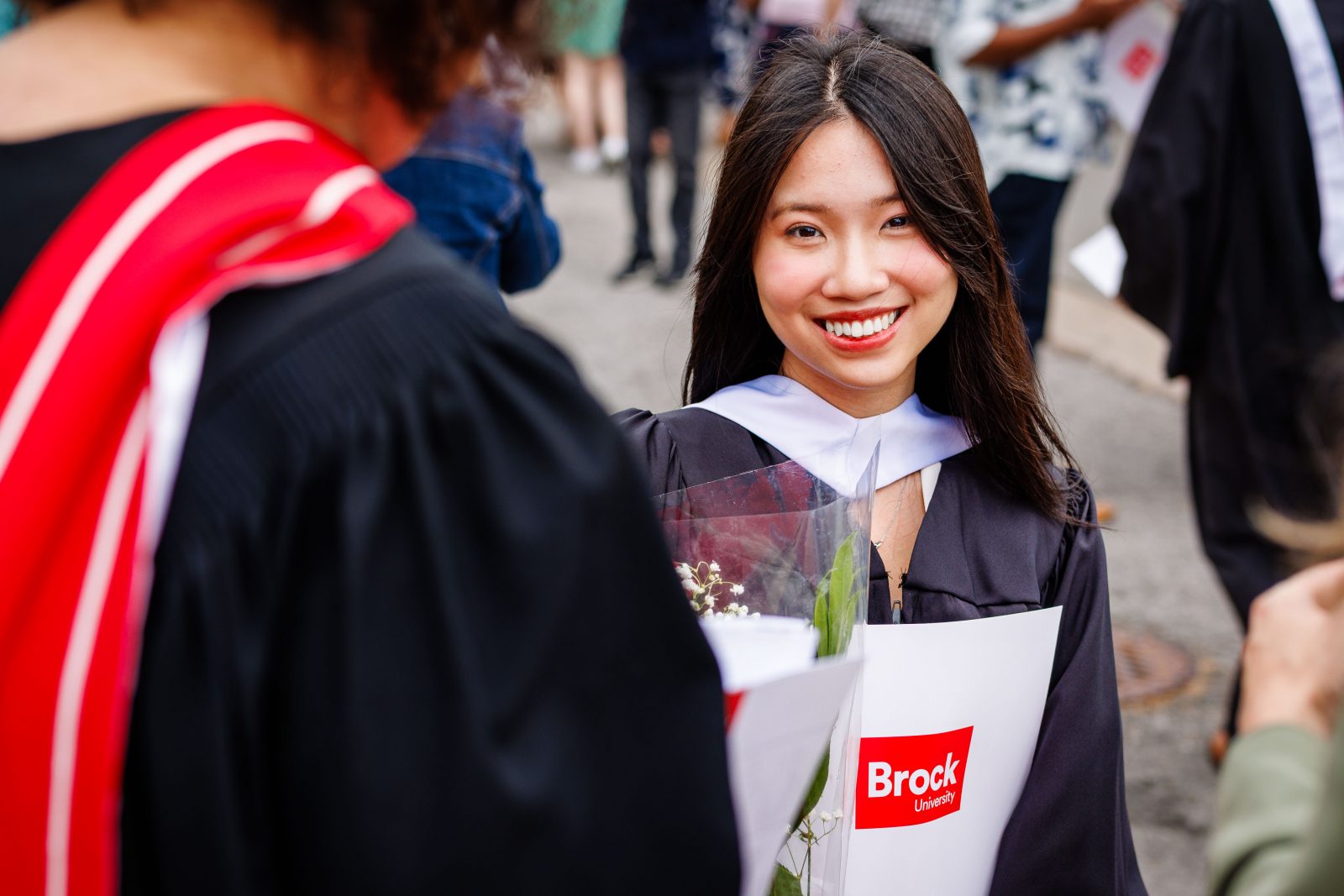
 At Brock’s 119th Convocation, international student Thuy Linh Dang fulfilled her vision of graduating with a Master of Arts in Applied Disability Studies.
On the toughest days of her research journey, Thuy Linh Dang (MA ’26) thought about her future Convocation day — along with the potential impact of her work — and pushed on.
That vision became reality on Wednesday, June 10, when Dang graduated with a Master of Arts in Applied Disability Studies during Brock University’s 119th Convocation.
Dang, who is disabled and has worked in disability advocacy and activism in Vietnam before coming to Brock for graduate studies, completed her master’s thesis research on the post-secondary education experiences of women from the Global South who have disabilities.
“The disability experience of international students is overlooked in research,” she says.
Through her research, Dang hopes to be part of the solution.
Supervised by Associate Professor of Applied Disability Studies Rosemary Condillac, Dang recruited six research participants from Africa, South and Southeast Asia and the Middle East. All were studying at colleges and universities in Canada and their disabilities included mental health conditions, physical disabilities and neurodivergence.
Dang says some key research findings include differences between students’ expectations and experiences, the impacts of social discrimination and challenges such as financial pressures, and difficulties accessing services and suitable housing.
However, she also highlights the ways in which the students actively navigated their circumstances to find ways to thrive, “developing survivor strategies that highlight their resilience.”
“My participants show how international education has transformative potential,” says Dang. “A lot of participants talked about what they learned and unlearned from Canadian education in terms of disability. Some saw disability as identity, but other participants discovered their disability when they came to Canada and embraced that with pride instead of always trying to stay away from it.”
Her thesis offers policy development recommendations and suggests ways institutions and communities can improve the experiences of international students with disabilities.
Dang says she was grateful for the chance to engage with other women who are international students with disabilities and “bring their stories to light.”
“I appreciate that they trusted me in sharing their stories, tears and laughter,” she says. “It’s not easy to tell stories about how you face challenges. A lot of participants talked about how they wanted to thrive and achieve academic excellence here as international students, but there’s not a lot of space to share vulnerability.”
Condillac says she was impressed by the strength of Dang’s research and her skills as a researcher.
“Linh possesses exceptional research potential, driven by her vibrant personality, scholarly excellence, passion and deep insight as a disabled scholar,” she says. “She stands out as one of the most dynamic, dedicated and determined graduate students I have ever supervised.”
After completing a Bachelor of Law degree in Vietnam with the hopes of becoming an advocate for people with disabilities, Dang began saving money to pursue an international graduate program. The Leadership, Diversity, Community, and Culture stream of Brock’s Applied Disability Studies program was a perfect fit.
“The program is very comprehensive in terms of the knowledge and the skills I wanted,” she says. “I really wanted to enhance my research capacity, but also gain Canadian experience with the internship. And as a person who works with disability service organizations, I wanted to learn about program evaluation and monitoring to develop programs that really serve the needs of communities.”
She completed an internship with the Brock-Niagara Centre of Excellence in Inclusive and Adaptive Physical Activity, served as an International Student Ambassador, and shared her personal experiences with the Brock community and the President’s Advisory Committee on Human Rights, Equity, and Decolonization.
Dang says her educational journey “has been a learning and unlearning process,” strengthening her analytical skills and deepening her capacity for self-reflection.
“Through engagement with decolonial disability studies, I have come to recognize how injustice is produced and sustained, to think critically about how to bring Global South knowledge to the forefront and to honour what we contribute to diverse ways of being and knowing in the world,” she says. “This drives my commitment to research and centres Global South voices, perspectives, and knowledge.”
Dang will continue to work as a research assistant at Brock as she prepares to publish her research findings and ultimately aspires to work in international development and disability advocacy.
“The participants chose me and they chose this research, so that is something that I find very meaningful,” she says. “I just hope that my research can carry their voices and the message to improve Canadian higher education, and also global higher education, in terms of international education opportunities for people with disabilities.”