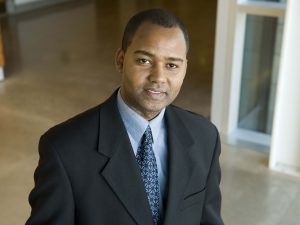
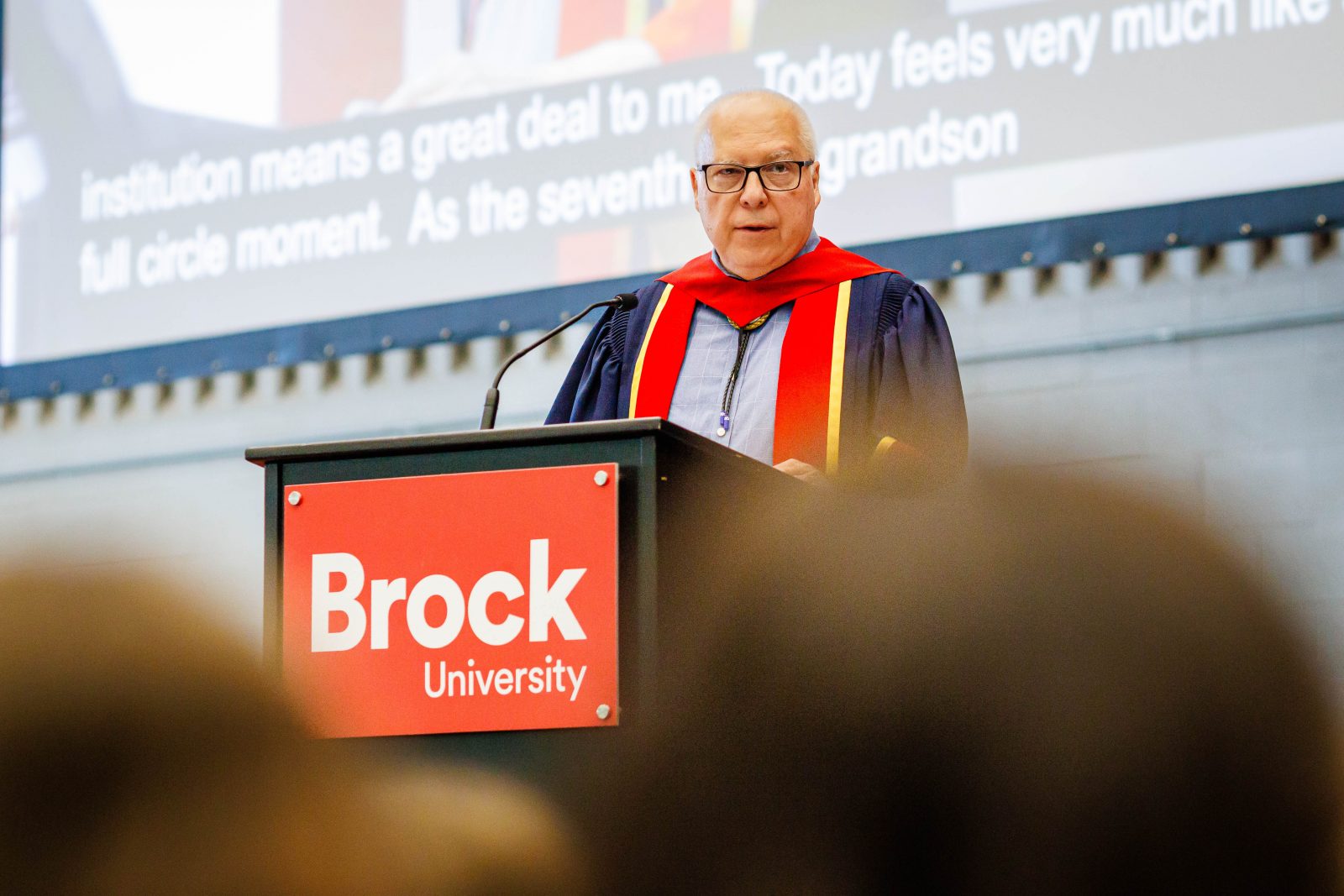
 Tim Johnson, President of the Niagara Academy for Indigenous Relations, received an honorary doctorate at Brock University’s 119th Convocation on Thursday, June 11.
Standing before a packed room of future educators, Tim Johnson was acutely aware of his audience and the power they hold.
As he delivered Brock University’s Convocation address on Thursday, June 11, the President of the Niagara Academy for Indigenous Relations hoped to ensure the new Faculty of Education graduates also understood the potential in their hands.
“The power of an educator lies not just in what you teach but in the curiosity you awaken in others and in your willingness to stand strong against pressure, whether quiet or overt, to settle for less,” he said.
Johnson, who has dedicated his more than 44-year career to sharing Indigenous history and cultures across North America, knows this responsibility — and the challenges that come with it — all too well.
The Brock honorary Doctor of Laws recipient, who was presented the degree at the morning Convocation ceremony, has faced his own pressures head-on with three key pillars guiding the way: knowledge, ethics and empathy.
He urged the Class of 2026 to consider leading the same way as they navigate a world saturated with misinformation and undue censorship.
As they enter their careers, the new graduates will encounter circumstances when knowledge, ethics and empathy will be challenged, Johnson said.
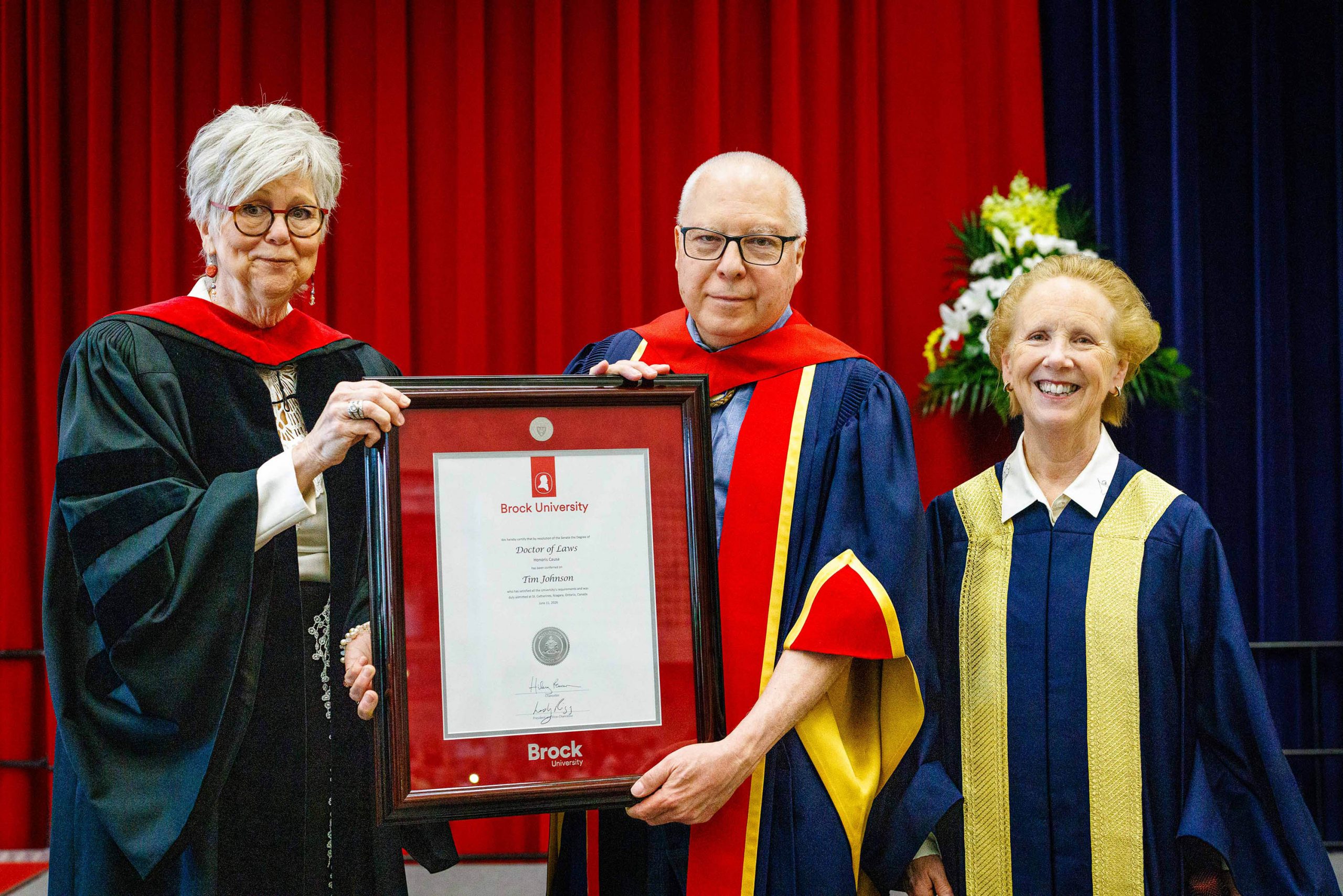
Tim Johnson (centre) receives his honorary Doctor of Laws from Dean of the Faculty of Education Mary-Louise Vanderlee (left) and Chancellor Hilary Pearson (right).
“These challenges will serve as tests of the merits of your Brock University education, of your commitment to evidence-based knowledge, of your character, of your ability to reason and of your essential humanity,” he said.
At times, it may mean “defending facts even when inconvenient or unpopular,” Johnson said, or the need to separate themselves from those “who do not hold the same standards.”
“Be prepared for that responsibility.”
Johnson said to defend evidence is to “defend the integrity of learning, ensuring that knowledge remains anchored in reason rather than shaped by assumption or bias.”
“To resist censorship is to defend the freedom to think, preserving the open exchange of ideas that allow truth and understanding to flourish,” he said. “And to practice empathy is to defend the humanity of every learner, including ourselves, nurturing a learning environment where dignity, understanding and growth can take root.”
Knowledge, ethics and empathy have served Johnson well through the years as he has worked to promote an accurate and effective understanding of the Indigenous experience.
Those key pillars supported him through his days as an Indigenous news columnist, editor and publisher, in his time as Associate Director for Museum Programs at the Smithsonian Institution’s National Museum of the American Indian and in his work curating exhibitions, public memorials, parks and artworks dedicated to Indigenous themes throughout the Niagara region and his home community of Six Nations of the Grand River.
Johnson left graduates with words of encouragement to harness their impact as they head out into the world.
“Feel proud of your accomplishments, commit yourselves to lifelong learning, apply your knowledge with confidence and building relationships with colleagues,” he said. “Now, go forth and make this a better world.”