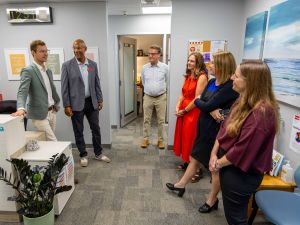
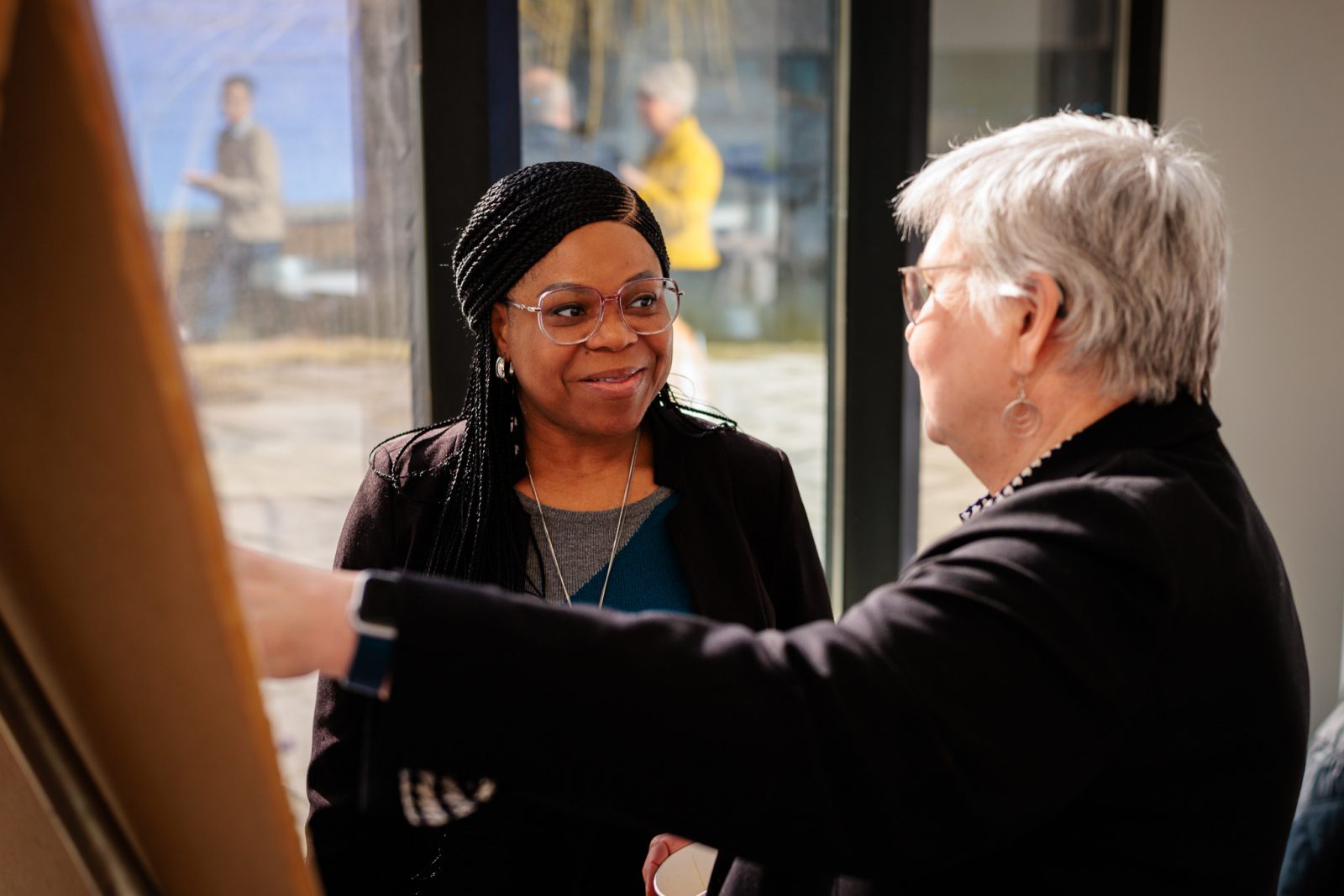
 PhD in Educational Studies student and Horizon Scholarship recipient Chinyere Saka (left) shared her research with Provost and Vice-President, Academic Arja Vainio-Mattila at a recent Faculty of Education research celebration.
 NOTE: This is one in a series of articles on Brock’s 2025-26 Horizon Graduate Student Scholarship recipients. Read other stories in the series on The Brock News.
Wenting Rong (MEd ’19) and Chinyere Saka are on a mission to give all learners the confidence to take charge of their futures.
At the heart of impactful research being done by the PhD in Educational Studies students and 2025-26 Horizon Graduate Student Scholarship recipients is a steadfast commitment to putting students first.
Saka, a Nigerian Canadian educator who has taught in both countries, brings a personal perspective to her research on the experiences of Black students in Ontario classrooms.
She has taught mathematics across Grades 9 to 12 for more than two decades and says at least one learner, including Black students, in every class told her they didn’t like math or weren’t “a math person.”
These statements stayed with Saka.
“It revealed to me how deeply students internalize their classroom experiences with mathematics,” she says.
A recent recipient of Brock’s Women in STEM Graduate Leadership Award, Saka is conducting research that aims to advance equity in mathematics education.
Her work explores the lived experiences of Black students entering Grade 9, which Saka describes as a pivotal moment.
“Students are in a new environment, forming new identities as learners and experiencing high-school level mathematics for the first time. This provides a powerful lens for understanding how belonging and identity begin to take shape,” she says.
Her research follows a change enacted in 2021 by Ontario’s Ministry of Education called “de-streaming,” which removed academic and applied math pathways so every student would take the same classes and have the same opportunities.
Saka believes that while the process was meant to equalize access to education, follow up is still needed.
“De-streaming mathematics created opportunities, but it is students’ lived experiences that will determine if equity is truly realized,” she says.
In her study, Saka uses participants’ stories and crafted narratives to illuminate how Black students experience the transition into Grade 9 mathematics.
Saka hopes to generate insight that will inform classroom practices, school leadership and board-level policy so all Ontario students can find success studying mathematics.
Receiving the Horizon Scholarship has been particularly meaningful for Saka.
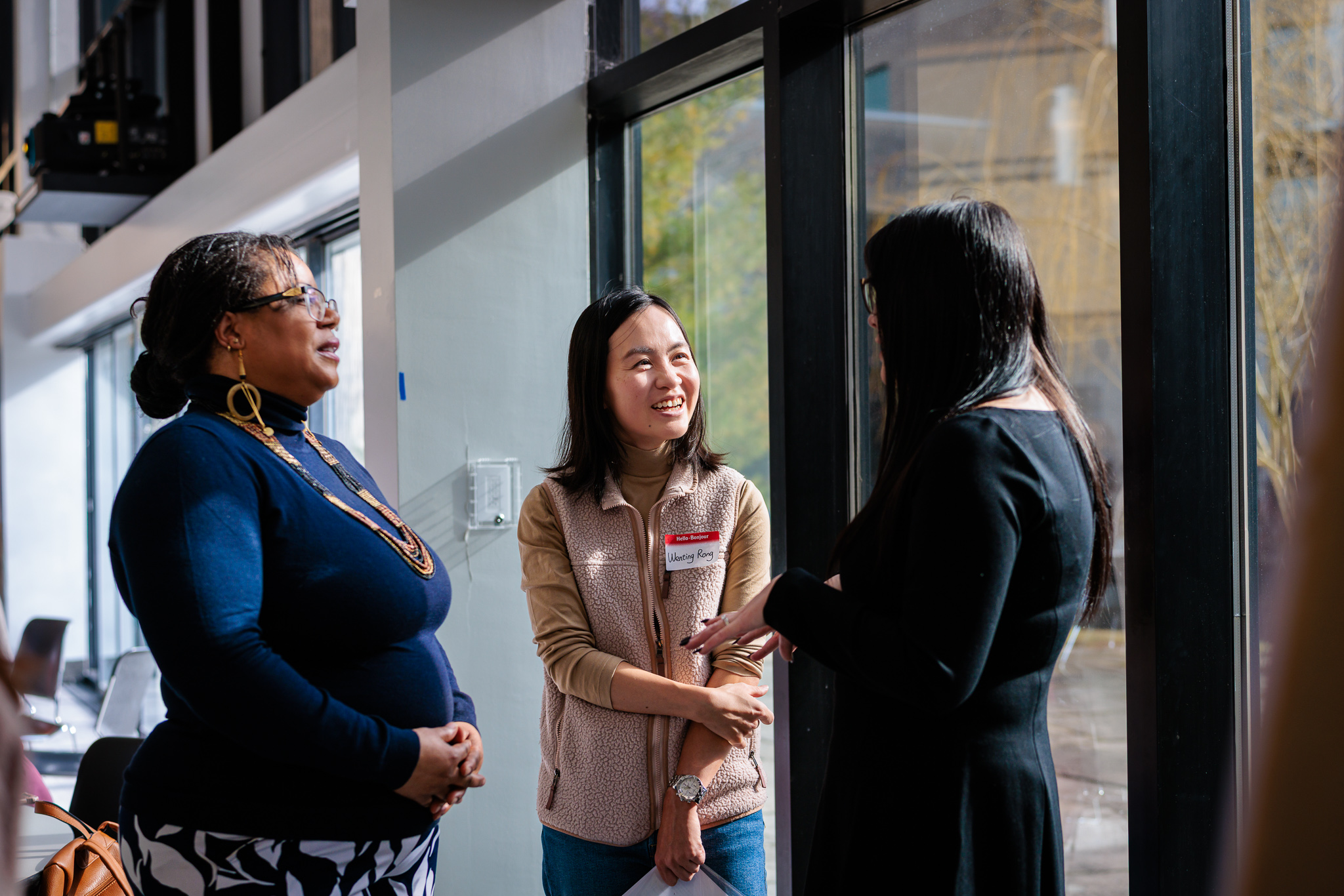
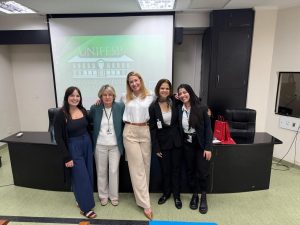
PhD in Educational Studies students Stacyann Williams (left), Wenting Rong (centre) and Robin Andrade recently presented their research at the Faculty of Education Celebration of Excellence in Research and Creative Activity. Rong has received a 2025-26 Horizon Graduate Student Scholarship.
“Brock has helped me grow as a researcher through strong mentorship and opportunities. I did not realize how transformative this journey would be for me,” she says. “I am motivated to continue my research to make an impact for students and schools.”
Like Saka, Rong’s journey at Brock has shaped her path in supporting the next generation of teachers and students.
A first-generation graduate student already holding a PhD in Engineering, Rong arrived at Brock eight years ago as a visiting scholar before completing her Master of Education.
Through her experience working with faculty and instructors in both Engineering and Education, Rong noticed that strong technical knowledge does not always translate into effective teaching.
“This led me to think more deeply about how we can better support teaching and learning,” she said.
Now embarking on her doctoral studies, Rong wants to support teacher candidates as they prepare to enter classrooms in Kindergarten to Grade 12 settings.
Rong’s passion lies in uncovering the possibilities of educational technologies for teaching science. She is pursuing research that explores leveraging new technologies in thoughtful and ethical ways.
“Given the recent boom in technological advancements including robotics and artificial intelligence, our educators need guidance on how to use these powerful tools to support learning. We can’t just bury our heads in the sand, we need to roll up our sleeves,” she says.
For Rong, science is alive.
“Science is so much more than concepts; it involves interactions, explorations and hands-on learning. The process is not a simple transfer of knowledge but instead helps students observe the world and learn how to ask questions,” she says.
A key element of Rong’s work explores how robotics can contribute to an engaging and inspiring learning experience, especially women and girls.
Rong combines her extensive experience in engineering with education to help shape curriculum for teacher candidates that will give them confidence with educational technologies when they reach the classroom.
“Thanks to technology, we have more choice now in how we can incorporate science and technology into education to support teacher education in exciting new ways,” she says.
Rong is also interested in teacher candidates’ digital literacy and how teacher education programs can better support the development of digital competence, building on her previous research in this area.
“This scholarship has given me the confidence and opportunity to continue my work supporting the next generation of educators,” she says.