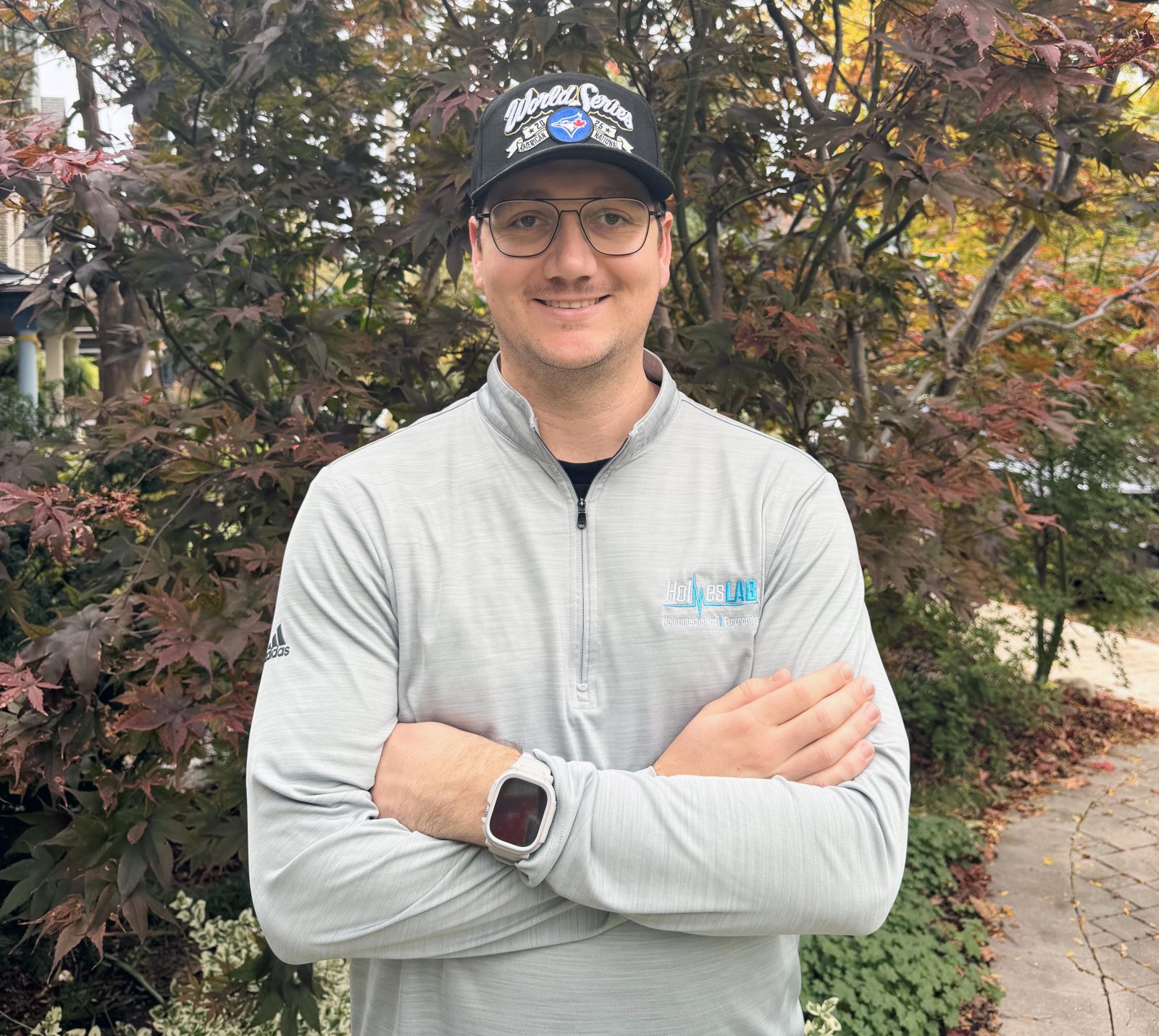
 Tyler Dobos’ (MSc '23) landed a job in the big leagues as first Pitching Resource Analyst for the Toronto Blue Jays after researching biomechanics while completing his master’s at Brock.
 When a shoulder injury derailed Tyler Dobos’ (MSc ’23) dreams of playing university baseball, he didn’t walk away from the game — he found a new way to stay in it.
His new plan, supported by his time in a Brock University Kinesiology lab, has since landed him a job as the first Pitching Resource Analyst for the Toronto Blue Jays.
“I really wanted to play but after my injuries, I just didn’t leave the game the way I wanted to,” Dobos says. “Looking back, I wish I had understood how much things like rest, recovery, sleep, nutrition and strength mattered. That’s what pushed me to learn how athletes can perform and stay healthy.”
His passion for the game was rekindled through his work at a baseball training start-up that ultimately led him to Brock.
His growing curiosity about movement, injury prevention and coaching led him to pursue a master’s degree at Brock, where he researched biomechanics under the supervision of Associate Professor of Kinesiology and Canada Research Chair in Neuromuscular Mechanics and Ergonomics Michael Holmes and adjunct Professor of Kinesiology Mike Sonne.
There, Dobos found the technical grounding and professional confidence that would serve him well throughout his career and ultimately secure him a job in the big leagues.
Using PitchAI, a motion-analysis technology co-developed by Sonne, Dobos examined how specific training drills impact pitching performance.
“Do the drills actually do what you want them to?” he says. “It was about supporting coaches with data-driven strategies.”
Dobos credits Brock for helping him grow as a critical thinker and collaborator.
“I came away with the confidence that I can figure anything out,” he says. “Even if I don’t know the answer right away, I know how to find it. That’s invaluable and something I’ve carried with me to this day.”
That mindset has served him well in his role with the World Series contenders. The job bridges biomechanics, analytics and on-field coaching, helping athletes refine their skills and reduce injury across the team’s development system.
Each year, Dobos’ work begins in Florida at the Blue Jays Player Development Complex in Dunedin, where spring training brings together players, coaches and staff from across the organization.
“Spring training is where everything connects,” he says. “We’re testing new training ideas, building individualized plans and making sure every pitcher — from Triple-A (AAA) through to Rookie Ball — has what they need to improve.”
His days are long and dynamic.
“I might start the morning breaking down biomechanical data, then heading out to the bullpen to watch our guys get their work in,” he says. “The next hour could be spent talking with pitching coaches about drill opportunities or working through a dynamic warmup progression with our strength coaches. You have to be ready for anything.”
Once regular season begins, Dobos travels across Canada and the U.S. to support the team’s affiliates. In the off-season, he returns to Toronto to plan, analyze and collaborate on new development opportunities.
“The off-season is where we have the time to slow down, reflect and ask bigger questions,” he says. “What worked? What didn’t? How do we build something better for next year?”
Dobos say the most surprising part of working in professional sport is the importance of relationship building and communications skills.
“You can have the data and science but if you cannot connect with people and earn their trust, the ideas don’t stick,” he says.
While his path from injured athlete to Major League Baseball analyst wasn’t linear, it taught him unforgettable lessons in adaptability that have propelled his career to great heights.
“I never imagined this is where I’d end up,” Dobos says. “But I’ve learned that if you keep learning, the right opportunities will find you.”