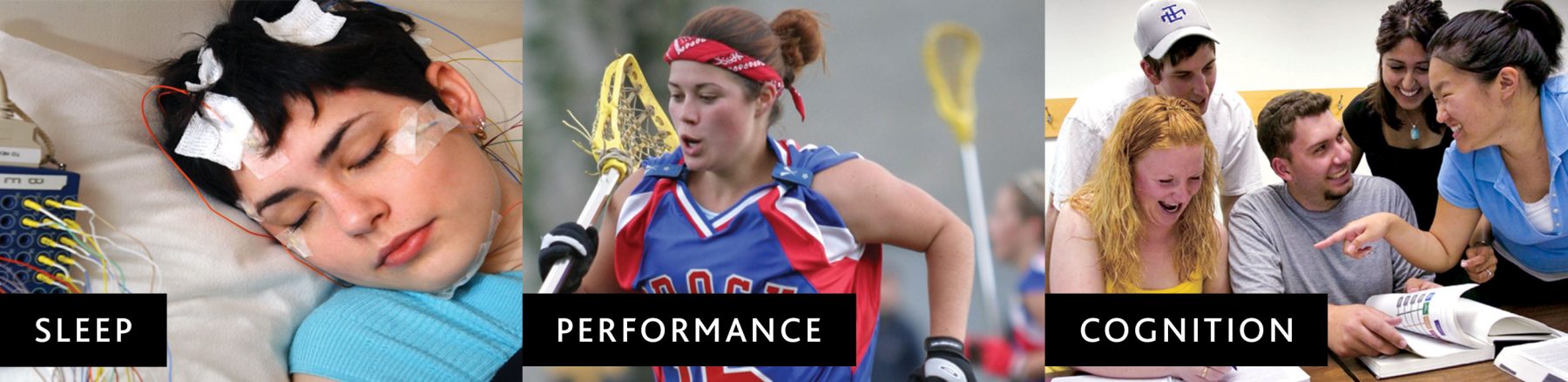
"Sleep, Performance, and Cognition"

Publications

Dr. Kimberly A. Cote

Chapters contributed to edited books


2. Cote, K. Chapter 329. Sleep, Biological Rhythms and Performance. Encyclopedia of Human Behavior, 2nd Edition, V.S. Ramachandran (Editor-in-Chief), Elsevier, in press.


1. Perlis, M., Gehrman, P., Terzano, M., Cote, K., and Riemann D. Sleep EEG in patients with Primary Insomnia. In: Insomnia: Diagnosis and Treatment. Eds. Michael J. Sateia, Daniel Buysse. Informa Healthcare USA, Inc. Chapter 6 pp.50-64. 2010. Essex UK.

Papers published in peer-refereed journals


24. Yasuda, K., Ray, L.B., and Cote, K.A. (2011). Anticipatory attention during the sleep onset period. Consciousness and Cognition, in press, available online: doi:10.1016/j.concog.2010.12.016


23. Kertesz, R.S. & Cote, K.A. (2011). Event-related potentials reveal failure to inhibit stimuli during the pre-sleep waking period for patients with sleep-onset insomnia.Behavioral Sleep Medicine, 9, 68–85.


22. Cote, K.A., Milner C.E., Smith, B.A., Aubin, A.J., Greason, T.A., Cuthbert, B.P., Kertesz, R.S., Wiebe, S., Duffus, S.E.G. (2009). CNS arousal, attention, and neurobehavioural performance in a short-term sleep restriction paradigm. Journal of Sleep Research 18, 291-303.


21. Milner, C.E., Cuthbert, B.P., Kertesz, R.S., & Cote, K.A. (2009). Sensory processing in waking, non-REM, and REM sleep states in good and poor sleepers. NeuroReport, 20, 331-336.


20. Milner, C.E., & Cote, K.A. (2009). Benefits of napping in healthy adults: Impact of nap length, time of day, age, and experience with napping. Journal of Sleep Research, 18, 272-281.

19. Cote, K.A., Milner C.E., Osip, S.L., Baker, M.L. & Cuthbert B.P. (2008). Physiological arousal and attention during a week of continuous sleep restriction. Physiology and Behavior, 95, 353-364.

18. Milner C.E., & Cote, K.A. (2008). A dose-response investigation of the benefits of napping in healthy young, middle, and older adult age groups. Sleep and Biological Rhythms 6, 2-15.


17. Fogel S.M., Smith, C.T., & Cote K.A. (2007). Dissociable learning-dependent changes in REM and non-REM sleep in declarative and procedural memory systems. Behavioral Brain Research, 180, 48-61.


16. Fogel, S.M., Nader, R., Cote, K.A., & Smith, C.T. (2007). Sleep spindles and learning potential. Behavioual Neuroscience, 121, 1-10.


15. Milner, C.E., Fogel, S.M., & Cote, K.A. (2006). Habitual napping moderates motor performance improvements following a short daytime nap. Biological Psychology, 73, 141-156.


14. Schmidt, L.A., Cote, K.A., Santesso, D.L., & Milner, C.E. (2003). Frontal electroencephalogram (EEG) alpha asymmetry during sleep: Stability and its relation to affective style. Emotion, 3, 401-407.


13. Cote, K.A., Milner, C.E., Osip S.L., Baxter, K.D., & Ray, L.B. (2003). Waking quantitative Electroencephalogram and auditory event-related potentials following experimentally-induced sleep fragmentation. Sleep, 26, 687-694. Commentary: Colrain I.M. (2003). Novel measures of daytime central nervous system function following sleep disruption. Sleep, 26, 650-651.


12. Werth, E., Cote, K.A., Gallmann, E., Borbély, A.A., & Achermann, P. (2002). Selective REM sleep deprivation during daytime: I. Time course of interventions and recovery sleep. American Journal of Physiology, 283, 521-526.


11. Huber, R., Graf, T., Cote, K.A., Wittmann, L., Gallmann, E., Matter, D., Schuderer, J., Kuster, N., Borbély, A.A., & Achermann, P. (2000). Exposure to pulsed high-frequency electromagnetic field during waking affects human sleep EEG. NeuroReport, 11, 3321-3325.


10. Cote, K.A. (2002). Probing awareness during sleep with the auditory odd-ball paradigm. International Journal of Psychophysiology, 46, 227-241.


9. Cote, K.A., de Lugt, D.R. & Campbell, K.B. (2002). Changes in the scalp topography of event related potentials and behavioural responses during the sleep onset period. Psychophysiology,39, 29-37.


8. Cote, K.A., Etienne, L. & Campbell, K.B. (2001). Neurophysiological evidence for the detection of external stimuli during sleep. Sleep, 24, 791-803.


7. Cote, K.A. & Campbell, K.B. (1999). The effects of stimulus intensity on eliciting P300 during REM sleep. NeuroReport, 10, 2313-2318.


6. Cote, K.A. & Campbell, K.B. (1999). P300 to high intensity stimuli during REM sleep. Clinical Neurophysiology, 110, 1345-1350.


5. Cote, K.A., Epps, T. & Campbell, K.B. (2000). The role of the spindle in human information processing of high intensity stimuli during sleep. Journal of Sleep Research, 9, 19-26.


4. Cote, K.A., de Lugt, D.R., Langley, S.D. & Campbell, K.B. (1999). Scalp topography of the auditory evoked K-complex in stage 2 and slow wave sleep. Journal of Sleep Research, 8, 263-274.


3. Cote, K.A. & Moldofsky, H. (1997). Sleep, daytime symptoms and cognitive performance in patients with fibromyalgia. Journal of Rheumatology, 24, 2014-2023.


2. Cote, K.A. & Ogilvie, R.D. (1995). Behavioural sleep/wake monitoring of insomniac and good sleepers. Canadian Journal of Behavioural Science, 27, 438-449.


1. Cote, K.A. & Ogilvie, R.D. (1994). Identifying sleep and wakefulness: A comparison of behavioural and polysomnographic methods. Journal of Psychophysiology, 8, 305-313.


Updated, July 2011