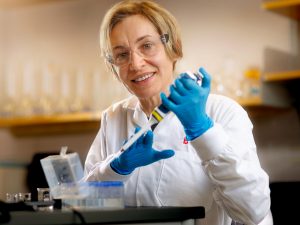
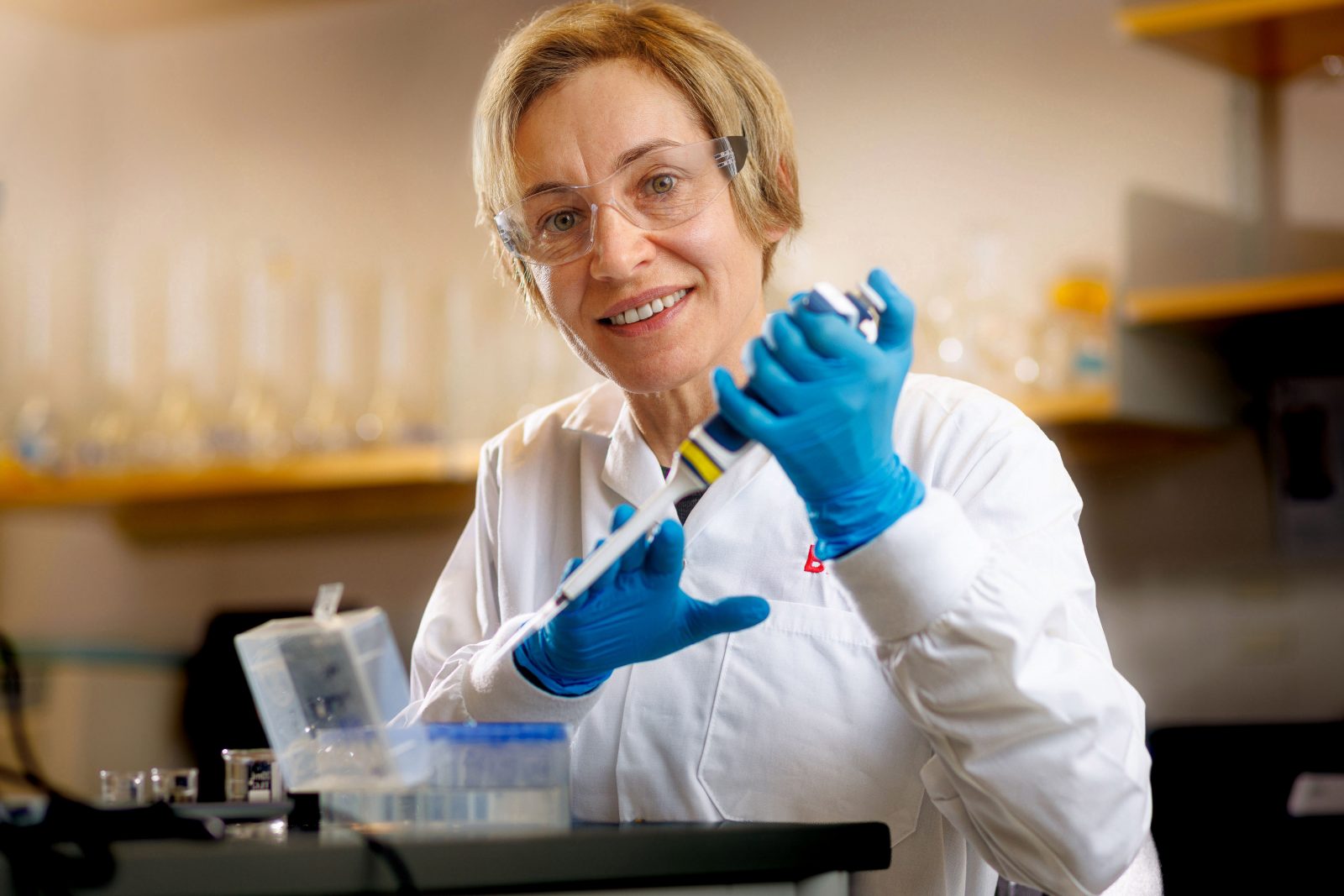
 Brock University Professor of Chemistry Anna Ignaszak and her research team are developing a device oncologists can use to monitor if tumours are expanding or shrinking in breast cancer patients following surgery and during chemotherapy.
Breast cancer patients need to undergo mammograms or other imaging tests to ensure tumours haven’t grown or reappeared following surgery and during chemotherapy.
But some of these imaging tests — particularly those involving radiation — carry risks to long-term health, are expensive to use or are in high demand causing delays in access, says Anna Ignaszak.
The Brock University Professor of Chemistry is researching a way to monitor if tumours are expanding or shrinking by building upon a current procedure that’s already part of a patient’s ongoing treatment, helping oncologists bypass the need for imaging tests.
“During immunotherapy or chemotherapy treatment, tubes of blood are collected and analyzed to see how the treatment is affecting the liver, kidneys or other systems,” she says.
“We’re investigating how to look for a specific biomarker in this blood showing the presence of the breast cancer tumour so that the oncologist can immediately see if the therapy is working without having to use expensive imaging procedures.”
Testing blood for the presence of tumour markers — proteins produced by cancerous cells or healthy cells in contact with cancerous cells — for early cancer detection has been around for a while.
While these might help identify specific blood cancers like leukemia, blood testing alone is insufficient to detect and diagnose breast, pancreatic, lung and most other cancers, says Ignaszak.
If anything unusual shows up, patients need to undergo further lab or imaging tests such as MRIs or CT scans.
Ignaszak’s team is focusing on ways to monitor developments in late-stage breast cancer rather than early detection, since the level of cancer biomarkers isn’t high enough early on for biosensor technology to pick up.
“The goal here is to assist oncologists in bypassing the delay of CT or MRI scans by catching molecular-level changes weeks or months before a physical tumour grows back,” she says.
To that end, the team developed the prototype of a device that measures the level of a protein called progranulin (GP88), a relatively new biomarker for breast and other cancers. GP88 fuels cancer cells and has been implicated in drug resistance.
GP88 enters the blood stream after it’s been secreted by the tumour cell, says Ignaszak.
“Normally when therapy works, the tumour shrinks very fast, which means it’s shedding off into the blood less and less,” she says. “If the oncologist looks at the progression of blood samples and sees the decrease of GP88, it immediately shows the therapy is working.”
Ignaszak and her team are using blood serum from both male and female patients to test out, and adjust, their prototype, taking a wide range of factors into consideration.
The next step, anticipated sometime next year, will be to start the process of clinical trials, she says.
Funding her research are the Government of Canada’s Natural Sciences and Engineering Research Council of Canada, Mitacs, the Canadian Space Agency and the Canadian Institutes of Health Research.
Ignaszak leads the Ignaszak Research Group, which specializes in the study of electrochemistry, used in innovations such as the personal glucose sensor.
In addition to detecting GP88 and other breast cancer markers in blood samples, the team is exploring the same approach for leukemia markers, blood coagulation markers and detection of Lyme disease-causing bacteria in urine.