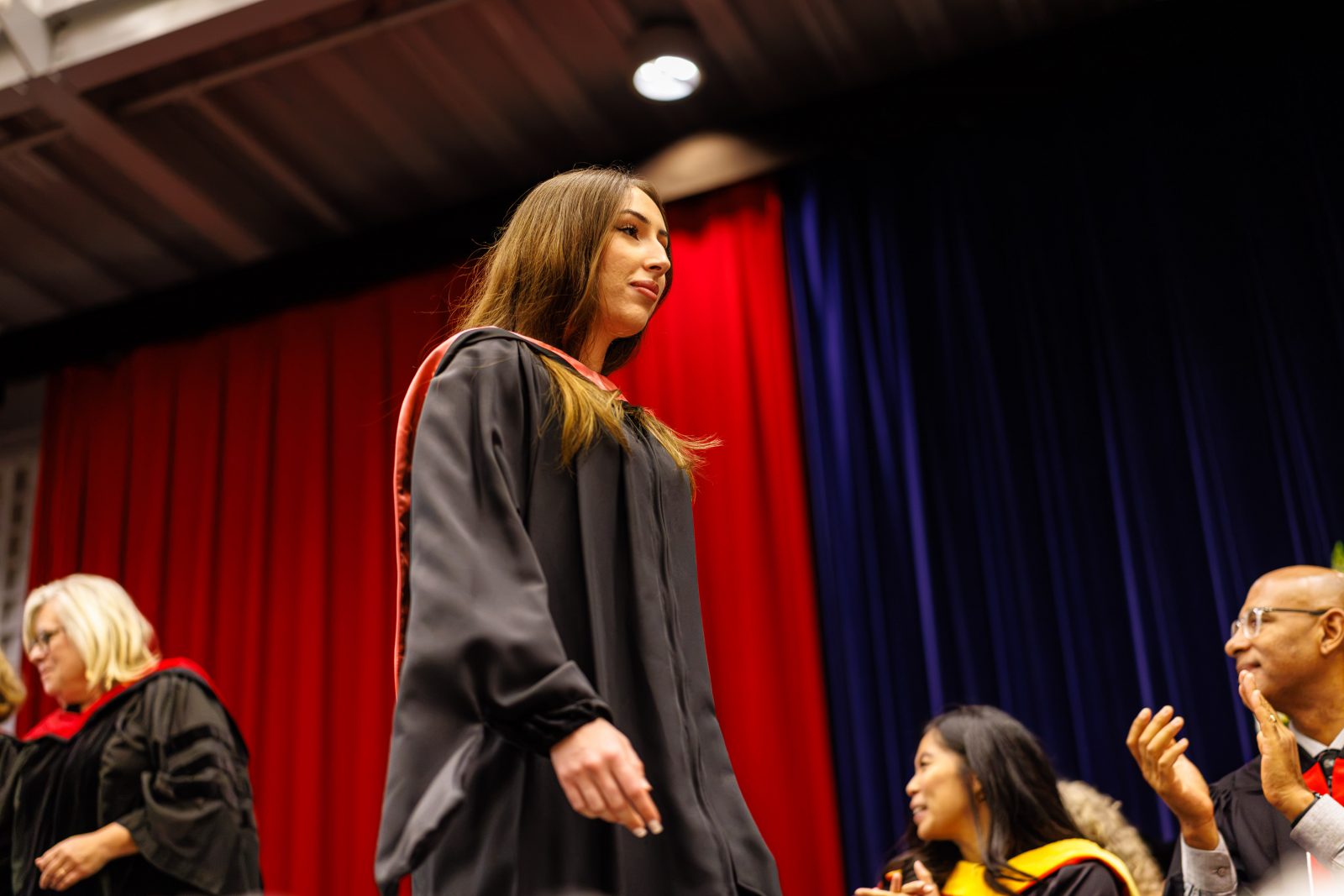
 Teodora Burgui (MPH '26) crossed the stage to receive a Master of Public Health degree on Oct. 16 during Brock University's 120th Convocation.
When Teodora Burgui (MPH ’26) crossed the Convocation stage last week, she did so with an unexpected new career path in sight — one she didn’t know existed before enrolling in Brock University’s Master of Public Health (MPH) program.
Burgui came to Brock looking for a graduate program that would allow her to gain practical health-care experience before deciding her long-term professional direction.
She chose Brock’s MPH for its blend of online courses and hands-on practicum opportunities — a decision that has reshaped both her understanding of health-care delivery and her career in the field.
During practicums, MPH students apply classroom learning in professional public health settings to solve challenges while developing skills in health systems, policy, research and leadership.
For Burgui, who was considering medical and dental school at the start of her degree, this experience also opened her eyes to new career possibilities.
“I honestly had no idea what health systems consulting was,” she said. “This practicum completely changed that. I realized I love solving complex problems by bringing together different perspectives.”
Working alongside Niagara Health oncology teams at a local cancer centre quickly showed her that behind every administrative detail is a patient and that even small documentation steps can help hospitals receive the funding needed to provide care.
Her practicum project focused on improving how oncology funding information is documented and understood across clinical roles. Working with managers, physicians, nurses and administrative staff, she developed a standard operating procedure explaining how each role contributes to Ontario’s funding model.
Over several months, she interviewed health-care professionals across the cancer centre, learned the terminology behind oncology funding and electronic medical records and observed the patient journey from registration through treatment.
“I had to understand every person’s role and their pain points before I could understand the problem well enough to build a solution that works for everyone,” she said.
Those conversations revealed that everyone, from physicians and nurses to administrative staff, viewed the challenge through a different lens.
As she learned more about the funding process, she also came to appreciate how seemingly minor administrative details could have broader implications.
For example, if a chemotherapy treatment is delivered but a required electronic timestamp or other documentation detail is not recorded, the treatment may not be fully reflected in provincial funding records. While patients still receive their care, incomplete documentation can affect how oncology services are reported for funding purposes.
“As a Brock graduate and former instructor, now leading at Niagara Health, I have seen how strong education and health-care partnerships strengthen both student learning and patient care. I am proud to have found a way to combine my experience at both of these top employers with the Master of Public Health students to enhance the care provided to people in Niagara with a cancer diagnosis,” said Tracy Fazzari (BA ’93), Director of Patient Care, Oncology and Palliative Care at Niagara Health. Brock signed a Memorandum of Understanding with the organization in 2019.
Observing the clinic first-hand also transformed how Burgui viewed heath care.
“I was surprised to see how many steps there actually are throughout the patient journey,” she said. “Seeing that made me appreciate how much co-ordination goes into every patient’s care.”
Looking ahead, she aims to pursue a career in health systems consulting while also applying to dental school. Through consulting and research, she aims to deepen her understanding of how care can be improved and bring that perspective into dental practice, with a focus on prevention and patient care.
“The biggest lesson was realizing that every role matters,” she said. “When you understand everyone’s perspective, you can build solutions that help both health-care teams and patients.”