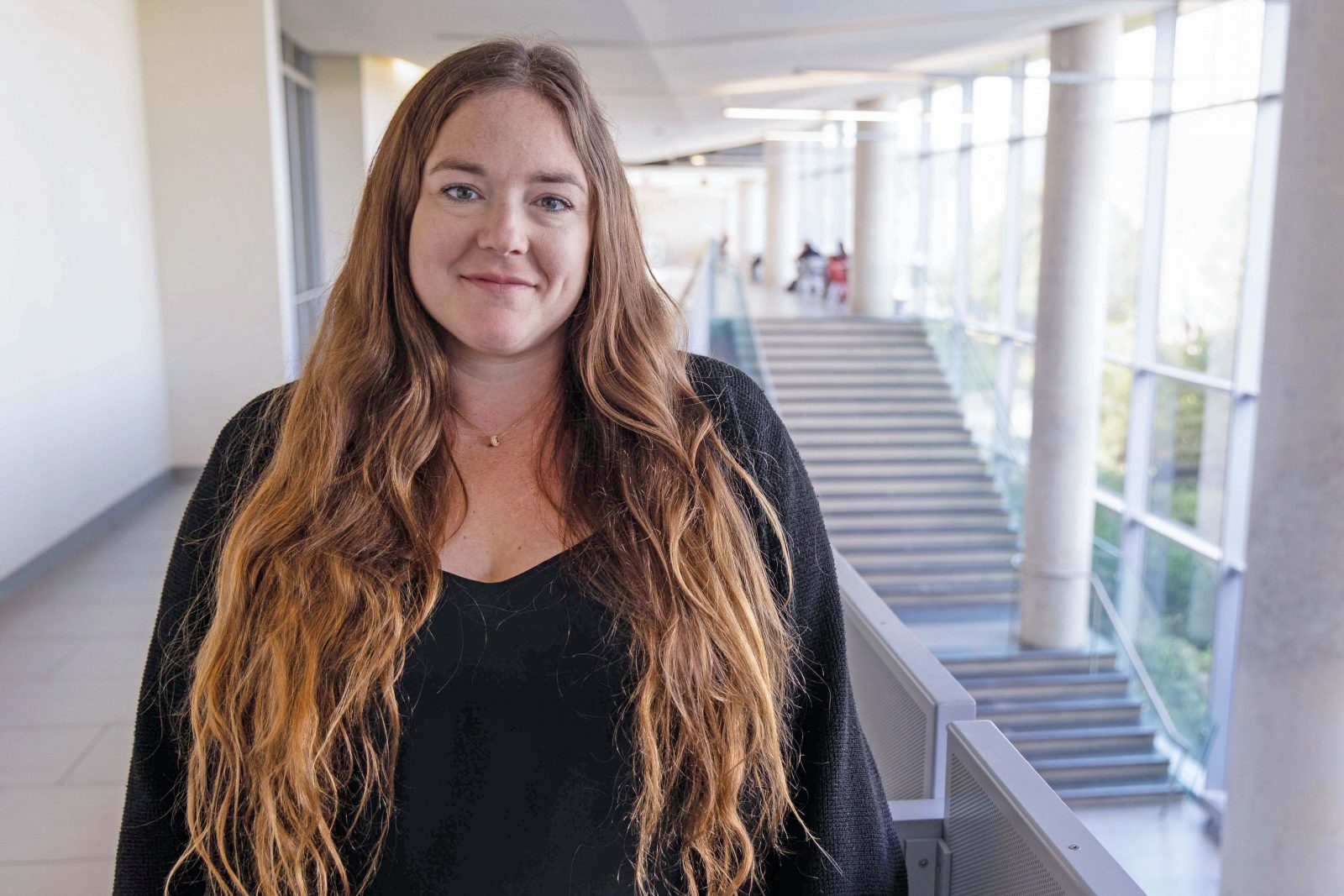
 Associate Professor of Child and Youth Studies Naomi Andrews plans to use her 2026 Chancellor’s Chair for Research Excellence award to study teasing behaviours in children and youth.
While surveying students about bullying in secondary schools several years ago, Naomi Andrews noticed an odd discrepancy.
Some students who got into trouble for bullying told Andrews they were joking or having fun with each other. But another said the school had a serious bullying problem that was widely ignored.
Andrews wondered if behaviours associated with playful joking and harmful bullying are qualitatively different experiences, even though they may look similar on the surface.
“Sometimes you call someone a name and you’re both laughing about it and having fun, and sometimes you call someone a name and it’s really hurtful,” says the Associate Professor of Child and Youth Studies. “What are the circumstances accounting for this difference? What are the complicating factors that make it okay or not okay to joke around?”
Andrews’ curiosity led her into a relatively new research area: teasing among children and youth, a focus she is developing with her 2026 Chancellor’s Chair for Research Excellence (CCRE) award.
“Dr. Andrews brings a fresh approach to the study of youth behaviour,” says Vice-President, Research Tim Kenyon. “Insights into the dynamics of teasing can be used to help youth develop healthy, positive relationships, which are so important for learning and well-being.”
With colleagues from the Departments of Child and Youth Studies and Psychology, Andrews is studying a group of more 750 children in Grades 5 to 8 for three years. Participants will fill out a survey once a year and some will undergo additional interviews.
Andrews asks questions around social, cognitive and psychological factors influencing how youth carry out, and respond to, teasing and how these interactions are experienced either positively or negatively.
Some of these factors could include whether someone is popular or has experienced bullying, their level of self-esteem and if they are dealing with mental health challenges such as depression and anxiety, she says.
“This builds on my prior work that separates playful, fun teasing from the really harmful teasing,” she says. “I hope to understand who is doing the teasing, in what context and why? And what are the outcomes?”
Through a pilot project conducted from 2022 to 2024, Andrews and an international colleague constructed a theoretical model mapping out the factors and steps involved in a teasing episode.
This model was based on surveys of more than 400 undergraduate university students and over two dozen in-depth interviews within that participant pool.
She determined her next step was to validate the model with adolescents as well as examine what led up to the teasing and what were the outcomes of that behaviour.
To that end, Andrews was awarded an Insight Development Grant last year from the Social Sciences and Humanities Research Council of Canada for her project, “Exploring nuance and complexity in youths’ teasing interactions: Advancing a conceptual model of playful and harmful teasing using a longitudinal, mixed-methods study.”
The grant enabled to start her current research. She and her team have collected the first batch of survey data in her three-year study and are processing that information.
“By better understanding the differences between teasing that is harmful or playful, we will be able to better inform teachers, principals, parents and others who work with youth to recognize the subtle differences in these interactions,” says Andrews. “These insights can guide educational prevention and intervention strategies to mitigate the negative impacts of harmful peer experiences.”
Andrews is also a member of the Brock Research on Aggression and Victimization Experiences (BRAVE) group, a team of researchers, professors, graduate and undergraduate students who study aggression to help prevent it and support those exposed to the behaviour.