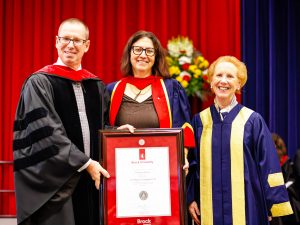
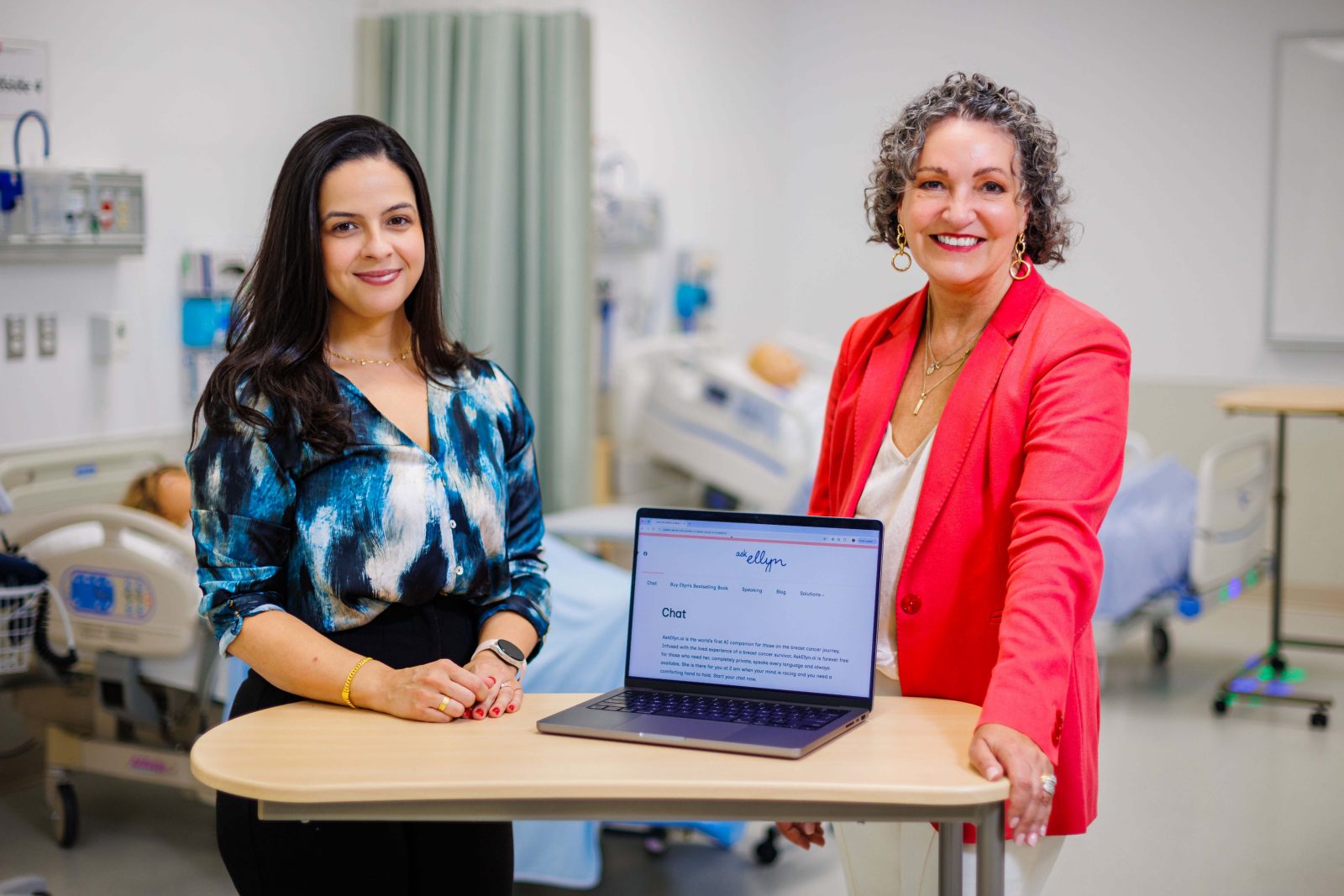
 Amina Silva (left), Assistant Professor of Nursing at Brock University, and Ellyn Winters-Robinson, CEO of The Lyndall Project and AskEllyn, are leading a national research project that will explore how AI companions can support breast cancer patients and their families.
 One in eight women will be diagnosed with breast cancer in their lifetime; among them, one in four will experience post-traumatic stress related to their diagnosis.
New research — funded by a Canadian Cancer Society Disruptive Innovation Grant — will explore how AI companions can provide empathetic support at scale, helping to alleviate anxiety for patients and caregivers affected by breast cancer.
Led by Amina Silva, Assistant Professor of Nursing at Brock University, and Ellyn Winters-Robinson, CEO of The Lyndall Project and AskEllyn, the national research project will bring together researchers, clinicians, patients and caregivers along with AI experts to study the effectiveness of AskEllyn, the world’s first AI companion for breast cancer.
As an agent for “conversational care,” AskEllyn offers non-medical support and companionship, rooted in the lived experience of Winters-Robinson, a fellow survivor.
Available at all hours of the day and in every language, AskEllyn provides support for patients, friends and family as they navigate the turbulent and emotionally taxing waters of a breast cancer diagnosis.
“Through my work in survivorship care, it has become clear that trauma associated with a cancer diagnosis is under-researched, and its impacts for patients and caregivers are not well understood,” Silva says. “We also have a health-care system that is overburdened, under-resourced and under strain, and a growing, diverse patient population for whom traditional support models may not be effective.”
Through the project, Silva says the research team will seek to study how AI can “play a vital role in meeting diverse user needs throughout the cancer journey, from initial diagnosis through to survivorship.”
As a breast cancer survivor, Winters-Robinson says she deeply empathizes with the trauma impacting diagnosed individuals and their families and acknowledges that those feelings do not vanish when active treatment ends.
“We created AskEllyn to fill that void, and the impact she has had over the past two years is nothing short of remarkable,” she says. “I am incredibly thankful to the Canadian Cancer Society for recognizing the importance of our work.”
Winters-Robinson says clinical evidence of AI as a patient support will pave the way for wider adoption and acceptance of AI-enabled conversational care.
“I am honoured to be a patient partner in this important study,” she says.
The Canadian Cancer Society’s Disruptive Innovation Grants provide a unique opportunity for researchers to test novel ideas with potentially game-changing impact in cancer prevention, detection or treatment.
“We’re here to support bold, imaginative ideas that break new ground — especially those that wouldn’t usually get traditional funding,” says Stuart Edmonds, Executive Vice President of Mission, Research and Advocacy at the Canadian Cancer Society. “Dr. Silva’s research stood out for its quality, and AskEllyn — a unique tool created by a survivor for survivors — has real potential to transform how patients support each other. As health-care resources are stretched thin, now is the time to consider how AI can improve care for those facing cancer.”
Patient recruitment for the project is now underway. To learn more about getting involved, contact Silva at [email protected]