Part III
Bringing it Together
Next we can combine the horizontal and vertical components to map the trajectory of a firework.
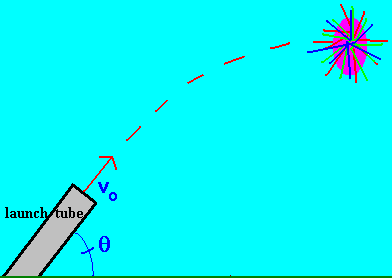
We may consider the x and y components to be independent of each other, but we need to know their individua l initial velocities to analyze them. The black powder that launches the firework has a certain strength. It will launch a firework at a particular initial velocity, but the angle of that velocity depends on the angle of the launch tube
We call the initial velocity vo and the launch angle, q.
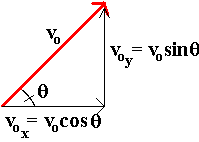
How do we break up vo into its vertical (voy) and horizontal (vox) components? TRIGONOMETRY! You can use the cos and sin functions to get the vertical and horizontal velocity components.
vox = vocos q
voy = vosin q
Question #1
What are the x and y initial velocity components of a shell fired at an angle of 80o with a speed of 60m/s?
Question #2
If you fire a shell at 45o, with a speed of 40m/s: **round all answers to 2 decimal places
Question #3
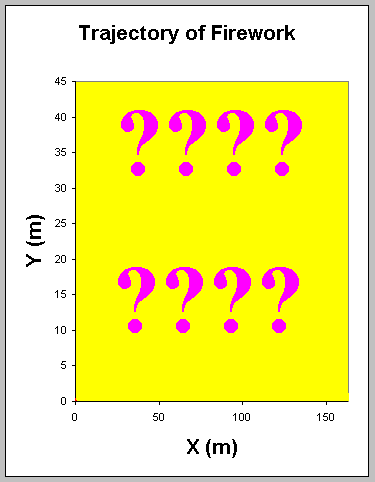
Sketch a graph of the trajectory of the firework in question 2. **Click on image below to see graph.
What if you know the horizontal and vertical components and need to find the total initial velocity? This is often the case with pyrotechnicians. Luckily, the vertical and horizontal components are at right angles to each other so we use PYTHAGORAS' THEOREM:
a2 + b2 = c2
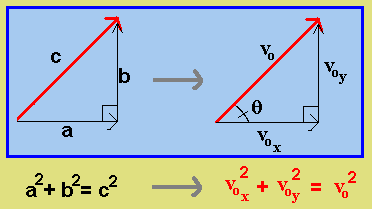
vox2 + voy2 = vo2
From this you can see that if you know the horizontal and vertical components you can solve for vo.
Question #4
You launch a firework with an initial vertical velocity of 50m/s, and an initial horizontal velocity of 20m/s.
EXTENSION QUESTION:
Notice that the trajectory is in the shape of a parabola. Given the two equations for horizontal and vertical motion of a firework, can you combine them into an equation for a parabola (quadratic equation)?