Next we will investigating the vertical (y) motion of a firework.
The equation for the vertical height of an object shot from the ground is:
What does Equation#2a look like? Question #1 a) Do the shapes of each of the above graphs look familiar? What do we call this type of graph? b) Compare Equation#2a to the graphs. What causes the graphs to open downwards instead of upwards? c) We can rearrange Equation#2a to look like: i) Expand this out to verify that it is the same as Equation#2a. ii) In this form, it is a little easier to imagine what the graph looks like. In which direction is the vertex shifted? Remember that a is negative! Now you can try the equation on a firework: Answer the following questions based on a shell that you have shot straight up into the air at an initial vertical velocity of 50m/s: Question #2 a) What is its height in metres after 10s? b) How long does it take until the shell returns to the ground? *Round your answer to 1 decimal place. c) What is the maximum height the firework reaches? *Round your answer to 1 decimal place. 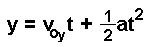 Equation#2a
=
=
=
=

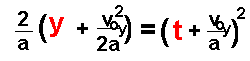 Equation#2b
The question below are a bit tricker but more realistic. Pyrotechnicians do not always have all the information they need. To figure out how high their fireworks will go, they test them out by firing shells into the air and timing them.
Question #3
a) You launch a firework and find that it returns to the ground in exactly 13.22s. How long did it take to reach its maximum height? *2 decimal places
b) What was its maximum height? Hint: Start your calculation from the top of its trajectory so that gravity is actually causing a positive acceleration. In this case the initial vertical velocity is the velocity the shell has at the peak of its flight, and the time is the same as in part i). *2 decimal places
c) What was its initial vertical velocity (speed when it left the ground)? *2 decimal places