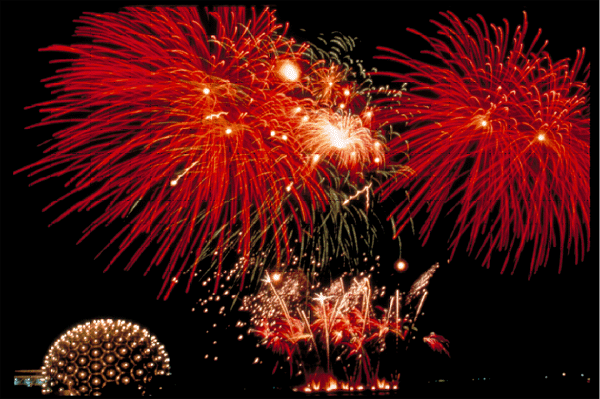
The Show
Image courtesy of http://www.celebration-of-light.com/fireworks/media/
Formerly called the Benson & Hedges Symphony of Fire, the HSBC Celebration of Light is a Vancouver fireworks show and is an annual event that is enjoyed by thousands. It features 4 nights during July and August of amazing fireworks diaplace in the heart of Downtown Vancouver's English bay. Although the name has officially changed to the HSBC Celebration of Light, most people still refer to it as The Symphony of Fire. You can see the fireworks from many places in the city, but the best viewing locations are English Bay, Kits Beach, and Jericho Beach.
Skip to : History of Fireworks What is a Firework? What Makes the Noise? Safety
Have you ever wondered who invented fireworks?
You may think it was some crazy scientist back a few hundred years ago, or maybe you think they were even a more recent invention. Well you may be surprised to know that we will have to travel back in time over 2000 years to hear the story of the first fireworks!
The most commonly believed story goes something like this. In China, as early as the 2 nd century B.C., (i.e. 2200 years ago) a cook was mixing together three chemicals now known to be the main constituents of gunpowder - salt petre (KNO 3), sulphur and charcoal. Upon lighting of this mixture, the cook was surprised to observe bright, colourful flames. The cook then decided to put some of this mixture into a hollow bamboo shoot and light it. Much to his amazement the cook observed an enormous, and very bright explosion, he had just made the first, albeit primitive, firework!
Within the next few hundred years of this discovery, the Chinese had implemented these early fireworks into everyday celebrations of events and rituals. It was believed that because of the loud explosions, fireworks would be effective at chasing away evil spirits. By 600 A.D., the gunpowder was being used as a part of Chinese warfare in the form of “fire arrows” and bombs.
 Although the Chinese are credited with the first fireworks, the development of fireworks into their form today was largely in part due to the Europeans. In roughly 1200 A.D. explorers like Marco Polo played a vital role in bringing this newly discovered explosive powder to the West. A variety of European scientists began to experiment with this gunpowder recipe by altering the composition of the three chemicals to maximize the explosion. The results of their experiments are still used today, as pyrotechnic experts still use the same composition that was established in 1550! In many European countries, pyrotechnics, the study of fire and fireworks, was even offered in schools. During medieval times, the British used fireworks at royal weddings, military victories and other celebrations, while the Germans among others used fireworks in battles.
By the mid 1700’s fireworks were being used in public forums as a source of entertainment in addition to their uses by royalty. In the 1800’s pyrotechnicians began to experiment with different metals in order to create different colours of fireworks, as up until this time, there was only one colour of firework. Around the same time, there were attempts to synchronize music to the firework shows, which has remained an important part of current firework shows.
Our story now reaches the fireworks of today. We now use fireworks for a variety of celebrations from national birthdays such as Canada Day, to New Year’s celebrations and sporting events. You are now prepared to learn some explosive math!
Professional fireworks are not just a bunch of chemicals stuffed in a tube. They are carefully designed to produce each explosion of colour and sound at exactly the right time.

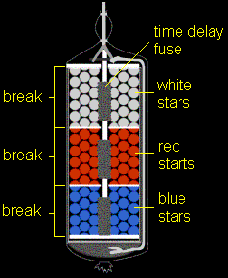
4. Stars – Stars are little balls of chemicals, which contain all the necessary ingredients for generating coloured light or other special effects. They may be as tiny as peas or as large as strawberries. Stars are dangerous because they can explode just from being bumped. Synthetic clothing, which generates static electricity, can create sparks capable of setting them off. Firework makers must stick to wearing cotton, right down to their underwear!
5. Break – Breaks are the divisions between compartments of stars. In a multi-break firework, stars are contained in separate cardboard compartments/breaks. The break's heavy wrapping keeps the gas and heat from reaching the bursting charge for as long as possible so that the explosion is very powerful. A firework's breaks may also contain sound charges, which result in the cracking bangs and thunderous booms that thrill audiences.
The answer is BLACK POWDER:
Black powder, or gunpowder, has remained the same since it was discovered in China about 1,000 years ago: 75% saltpetre (potassium nitrate), 15% charcoal, and 10% sulphur. Black powder is a "low explosive," meaning its detonation velocity is less than about 100m/s. ("High explosives" like dynamite have a velocity of detonation greater than 1000m/s.)
Black powder has two purposes in a firework:
***Sometimes to produce extra loud or special sounds, pyrotechnicians will include a "sound charge" in each break. When the fuse burns through the break the sound charge goes off, making that extra loud BANG!!
So what makes all those beautiful colours? See the Colours activity to find out!
Public fireworks displays are conducted by trained, licensed professionals, who know and comply with all local regulations. These professional shows are the safest way to enjoy fireworks, however there are some tips that should be followed to help make the display as safe and enjoyable as possible:
Spectators should obey all ushers or monitors and respect the safety barriers. Stay a safe distance away from the display.
Pets have very sensitive ears and the booms and bangs associated with fireworks can be damaging. Leave pets at home if you are going to a fireworks show.
Leave the lighting of all fireworks to the trained professionals. Sparklers, and explosives that may be allowed for use by private individuals are not safe to use when a large crowd is present. Leave your own fireworks at home - the display will provide plenty of excitement.
Sit back, relax and enjoy the show!
Fireworks are not toys. They are burning at extremely hot temperatures, and they can cause serious injury or even death. In Canada, fireworks are strictly regulated through the Explosives Act, which is administered by the Explosives Regulatory Division (ERD) of Natural Resources Canada. Any firework possessed in Canada must be on the list of authorized explosives. The ERD web page, http://www.nrcan.gc.ca/mms/explosif/over/over_e.htm, should be consulted for fireworks safety information, and regulations, but the following are some important tips to keep in mind:
image from www.middlemarch.co.nz