|
|||||||||
|
To simplify the mathematics we need to use, suppose we neglect friction and suppose that the trajectory of the skier is determined only by the shape of the ramp and by gravity. Then we can consider the skier as a projectile and use calculus to find their trajectory after leaving the bottom of the ramp. We assume that the skier will acquire an initial vertical speed V0 that they will leave the ramp at an initial height h, measured in metres, and that upward speed is considered positive and is measured in metres per second. At this point we can describe the post-ramp trajectory of the skier
by considering the equation Let us perform the process of integration and use the initial conditions to find the constants of integration. Assume that the initial vertical speed of the skier at the instant they leave the ramp is V0 = 15 m/s, and that the initial height of the skier at that point is h = 5 m. This gives us the following expressions for the vertical speed V(t) and the displacement S(t). V(t) = -gt + V0 = -9.8t + 15 S(t) = - (g/2)t2 + V0t + h = -4.9t2 + 15t + 5 We are now in a position to ask several questions about the path of the skier and use the equations above to find reasonable answers. |
|||||||||
|
|||||||||

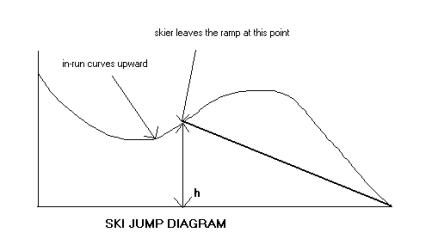
 Suppose we are interested in
the motion of a skier participating in the ski jump. We use our
knowledge of basic Physics and Mathematics to reason that after
the skier begins their descent from the top of the ramp or in-run,
they subject to forces such as gravity, ramp friction, and air friction.
As in a roller coaster, the energy for a jump is generated by gravitational
potential energy reached by ascending to the top of the hill. Near
the end, the in-run begins to curve upward, as shown in the diagram
above, and the skier leaves the in-run with both a vertical and
horizontal speed.
Suppose we are interested in
the motion of a skier participating in the ski jump. We use our
knowledge of basic Physics and Mathematics to reason that after
the skier begins their descent from the top of the ramp or in-run,
they subject to forces such as gravity, ramp friction, and air friction.
As in a roller coaster, the energy for a jump is generated by gravitational
potential energy reached by ascending to the top of the hill. Near
the end, the in-run begins to curve upward, as shown in the diagram
above, and the skier leaves the in-run with both a vertical and
horizontal speed. = -g, where V is the vertical speed of the skier, g
is the acceleration due to gravity of g = 9.8 m/s2,
and time t is measured in seconds. Suppose we express the
initial conditions as V(0) = V0 and S(0)
= h. Here S is the vertical displacement and both
the initial conditions are expressed at time t = 0. The
differential equation and the initial conditions can now be recognized
as an initial value problem. To solve this system we use the fact
that the relationship between displacement and velocity is expressed
by the equation
= -g, where V is the vertical speed of the skier, g
is the acceleration due to gravity of g = 9.8 m/s2,
and time t is measured in seconds. Suppose we express the
initial conditions as V(0) = V0 and S(0)
= h. Here S is the vertical displacement and both
the initial conditions are expressed at time t = 0. The
differential equation and the initial conditions can now be recognized
as an initial value problem. To solve this system we use the fact
that the relationship between displacement and velocity is expressed
by the equation  = V(t). To solve this initial value problem we need
to use only simple integration, or anti-differentiation, twice.
= V(t). To solve this initial value problem we need
to use only simple integration, or anti-differentiation, twice.

