Main

  • Holocaust Education Week, 2025

    Brock Library thanks Brooke Braverman and Perla Zaltzman of Brock Chabad for this exhibit and blog post. Visit the display in the Matheson Learning Commons until November 14. 

    Places can be deceiving. Where grass and trees now grow, once were scenes of unspeakable horror — killing fields where more than 2 million people 
were murdered before the creation of concentration camps. “Holocaust by
Bullets” documents this lesser-known side of the Holocaust. This exhibit makes sure that the victims won’t be forgotten.

    Between 1941 and 1944, thousands of killings took place across seven Soviet republics. The estimated number of Jews exterminated was at least 2.2 million. This included 1.6 million victims in Ukraine, 500,000 in Belarus and at least 120,000 in Russia. Over 80% of the victims were shot, while the rest were deported or murdered in the death camps or in gas vans. The death of Soviet Jews was not called “Holocaust by Bullets” for nothing. The statistical murder by shooting was used in Eastern Europe, in small towns or in a large Soviet occupied city. Often these shootings were done outside of villages and towns, against women, men and children.

    During Holocaust Education Week, Chabad at Brock presents “Holocaust by Bullets,” an exhibit featured in the Thistle Corridor and the Learning Commons of the Brock University Library. Curated by Perla Zaltzman and Brooke Braverman, this display brings together the “Holocaust by Bullets” story in the Thistle Corridor from Yahad in Unum, while highlighting the Brock students who are descendants of Holocaust survivors, in the Learning Commons. Through these narratives, we reflect on the fallen Jewish people forgotten during the Soviet Holocaust, while commemorating the resilience needed to carry the memories of the survivors.

    In the Thistle Corridor, the organization, Yahad in Unum, devotes its research to the Holocaust, fighting antisemitism, and fostering relations between Catholics and Jews. By combining both Catholic and Jewish relations, the organization uses “Yahad”, which is the Hebrew word for “Together”, while in Latin, “In Unum” means “in one”. The organization seeks to uncover the lesser-known chapter of history, “Holocaust By Bullets”, which has been silent for too long.

    Additionally, the library has curated a collection of books to support Holocaust Education Week, offering historical insights, survivor testimonies and scholarly perspectives on antisemitism and resilience.

    We invite you to explore and reflect on the stories, messages and meaning of the exhibits. In bearing witness to this history, we commit to fighting antisemitism, hatred, bigotry and silence, wherever they may appear.


    Tags: ,
    Categories: Learning Commons, Main

  • Brock Library collaboration featured in new Lincoln Museum exhibit 

    Brock Library is proud to have contributed to the Lincoln Museum’s newest exhibit, Through the Grapevine: Winemaking in Niagara, which opened on Thursday, October 30th in Jordan, Ontario. The exhibit explores the rich history of winemaking in the Niagara region—from its early roots to the thriving industry it is today—and will be on display through to October, 2026.

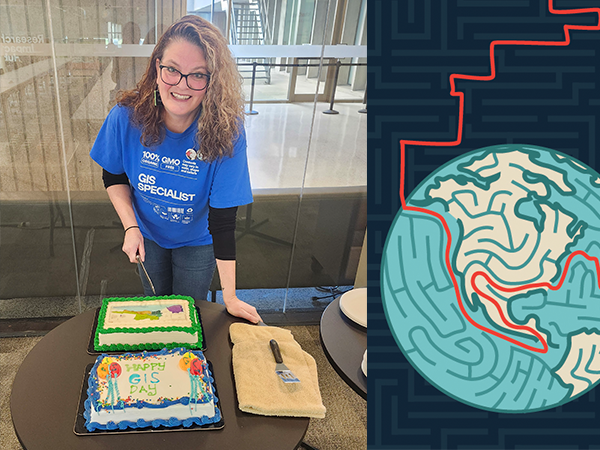
    As part of this collaboration, Sharon Janzen, Brock’s Maps, GIS & Geospatial Data Specialist, created a detailed map illustrating Niagara’s wine sub-appellations, highlighting the geography that shapes the region’s distinctive wines. Complementing the map, Derek Schneider, Makerspace Manager, developed a 3D model of the mapped area designed as an interactive puzzle, allowing visitors of all ages to assemble the terrain piece by piece.

    This project showcases how Brock Library supports and celebrates local heritage through innovative uses of spatial data, design, and technology. It also highlights the creative possibilities that emerge through campus and community collaboration.

    Interested in exploring partnership opportunities or learning more about what we do? Get in touch at [email protected].

    Tags: , , ,
    Categories: Main, Makerspace, MDGL

  • A reflection on Islam’s timeless love of learning and beauty

    October is Islamic History Month in Canada. In celebration, the Brock Muslim Students’ Association has developed an exhibit at the Learning Commons Thistle entrance highlighting the work of Islamic scholars and artists throughout history. Visit the exhibit until October 31.

    Brock Library thanks the Muslim Students’ Association for this blog post. 

    Knowledge as Light

    Guided by the Quran’s call to “seek knowledge”, a duty for men and women alike, Muslim scholars sparked a civilization of learning.

    Between the 8th and 14th centuries, cities like Baghdad, Cairo, and Cordoba became centers of ideas, where scholars preserved ancient knowledge, and expanded it with new discoveries in medicine, astronomy, and mathematics.

    It is widely argued that the European Renaissance was primarily made possible due to the Islamic Golden Age.

    Knowledge as Light – the Quran

    The Qur’an teaches Muslims to seek knowledge as a lifelong duty and a form of worship. From the first revelation — “Read in the name of your Lord” (Qur’an 96:1) — believers are urged to learn, reflect, and understand the world as a way of recognizing Allah’s signs. It promises high ranks for those who gain knowledge (Qur’an 58:11) and reminds us that true understanding deepens faith (Qur’an 35:28). In Islam, learning isn’t limited to religious study; it includes all knowledge that benefits humanity. By seeking wisdom with sincerity, Muslims grow closer to Allah and help build a more enlightened and just society.

    Al-Khwarizmi (c. 780–850) – Father of Algebra

    His Kitab al-Jabr introduced systematic solutions to linear and quadratic equations and gave us the word ‘algorithm’.

    Ibn al-Haytham (c. 965–1040) – The Scientific Method

    Through experiments on light and vision, he laid the groundwork for modern optics. His studies helped shape the design of cameras and lenses centuries later.

    Ibn Battuta (1304–1369) – The greatest traveller of the medieval world

    Over 30 years, he journeyed across Africa, Asia, and Europe, documenting cultures and geography in vivid detail. His Travels expanded the world’s understanding of global civilizations.

    Art & Architecture

    Islamic art includes not only religious works like mosques and their furnishings but also the rich art and architecture created across Muslim lands. Drawing on Byzantine, Sasanian, and Greco-Roman traditions, it evolved a distinctive visual language under the guidance of faith.

    A defining feature is aniconism (the avoidance of human or animal figures in religious contexts) which encouraged artists to explore abstract designs, intricate geometric patterns, and the flowing beauty of Arabic calligraphy.

    Arabesque & Patterns

    Islamic art heavily involves patterns, especially arabesques, with repeating geometric shapes and flowers. They symbolize the endless and perfect nature of God, and sometimes small “mistakes” are left on purpose to show humility. These designs make walls, doors, and floors feel alive with movement and rhythm.

    Islamic Calligraphy

    A central pillar of Islam is the belief in one God; therefore, any form of idolatry is forbidden. Muslims avoid depicting humans and animals mainly to prevent idolatry, as creating living forms is considered a unique act of God. This led to a greater focus on incredibly intricate Arabic calligraphy, written in beautiful, flowing styles on books, walls, and objects. Calligraphy serves both as decoration and as a way to highlight the importance of the words themselves.

    Islamic Architecture & Mosques

    Mosques are the heart of Islamic cities, inspired by Muhammad’s home in Medina. They mix Roman, Byzantine, and local styles, with big domes, tall minarets, and open courtyards. Famous examples like the Dome of the Rock and the Blue Mosque with both beauty and clever design.

    For More on Islamic Art & Architecture


    Tags: , ,
    Categories: Learning Commons, Main

  • Doing OK? – a campus-wide mental health campaign

    Brock Library thanks Bailey O’Hagen, Wellness Navigator in the Student Wellness and Accessibility Centre for this exhibit and blog post. Visit the display in the Matheson Learning Commons until October 31. 

    This year, The Wellness Navigators and The Wellness HUB are shining a spotlight on their Doing OK? mental health campaign—an initiative focused on building a compassionate campus where students have the skills and confidence to reach out and support one another.

    Our library display highlights the campaign’s key message of “Doing OK?”—a reminder to check in on a friend. University life can get busy with classes, deadlines, and everything in between, and it’s easy to get caught up in the rush. Through this display, we wanted to reflect on how important it is to take the time to pause, connect, and reach out. Sometimes, it can be as simple as sending a friend a message asking, “How are you doing?”—a small question that can open the door to meaningful conversation and support.

    This campaign encourages students to regularly check in on their friends and loved ones. It focuses on building awareness around the importance of reaching out, recognizing when someone might need extra support, and knowing how to have these conversations with their friends.

    The campaign follows these five steps to guide your check-ins:

    1. Recognize the Signs – Noticing the Changes in mood, behaviour, or routine may signal that someone is struggling.

    2. Ask – A simple “Are you doing OK?” can go a long way.

    3. Listen – Be present, and let them share without judgment.

    4. Encourage Action – Gently support them with next steps – whether it’s reaching out to a resource, a trusted person, or using a coping strategy.

    5. Check Back In – Continued support shows you care and builds trust.

    Together, we can create a campus where compassion and connection thrive.

    The “Doing OK?” campaign is part of the Student Wellness and Accessibility Centre (SWAC). To learn more about the campaign and explore mental health supports and resources, visit our Doing OK? page.

    Tags: , ,
    Categories: Learning Commons, Main

  • A 10-minute European vacation awaits

    “Broad, wholesome, charitable views of men and things cannot be acquired by vegetating in one little corner of the earth all one’s lifetime.”
    ― Mark Twain, The Innocents Abroad

    The Department of Modern Languages, Literatures and Cultures welcomes you to browse through its latest exhibit in the Library and at the Thistle entrance to the Learning Commons. The display exemplifies the languages and unique cultures explored by MLLC students. May your curiosity be piqued and perhaps some of the questions rooted in the history of these cultures will be raised by the materials on display.

    Tags: ,
    Categories: Learning Commons, Main

  • Reconciliation and libraries: cleaning up descriptions of library materials

    As part of the 2025 Truth and Reconciliation events, the Brock Library hosted a discussion of reconciliation work as it applies in the context of library metadata.

    Since the release of the Truth and Reconciliation Report in 2015, libraries in Canada have been hard at work implementing the Calls to Action related to memory institutions (C.T.A. 79). One particular area of concern is metadata: the descriptions which represent material in a library’s collections and allow it to be searched for and discovered. Metadata can, and often does contain outdated and harmful terminology.

    What are libraries doing to address these problems and move to language which is inclusive and respectful of the communities, people, and knowledge represented in them? What are some of the challenges of this work? In this presentation, Brock Metadata Librarian, John Dingle shared the Library’s harmful metadata remediation strategy for the general collection, while David Sharron, University Archivist spoke about this work in the context of the Archives and Special Collections.

    View the presentation on YouTube.
    Duration: 1 hour

    Tags: , ,
    Categories: Main

  • Notice: Potential service disruption

    As of September 25th, the Canadian Union of Postal Workers (Canada Post) are on a national strike. Some of our interlibrary loan and resource sharing services, specifically physical items to and from our Canadian partners, will be affected by this strike. Please expect delays for the duration of the labour action.

    Interlibrary loans will continue as usual with our Ontario university library (Omni) partners and international lenders. Digital resource sharing in the form of articles and book chapters is unaffected, and can be used as a great alternative during this time.

    Questions about interlibrary loans services and delays can be directed to [email protected]. The Brock University Library resource sharing team is here to help with your research.

    Tags: ,
    Categories: Main

  • Burlington Campus Library opportunity

    Brock University Library is hiring a Library Coordinator for our new Burlington Campus location.

    The Coordinator oversees the daily operations of the Library. In addition to providing front-line desk services alongside Burlington Public Library staff, the position collaborates with Brock and Burlington colleagues, staff, faculty and librarians to develop and deliver instruction and training, and to enhance collections and services for Brock University programs located at the Burlington campus. The Library Coordinator provides library research help and proactively promotes user engagement through events and outreach.

    Learn more about the role and apply by October 5, 2025.

    Tags: ,
    Categories: Main

  • Career Opportunity

    Brock University Library is recruiting a Circulation Clerk for our User Services & Engagement department.

    Circulation Clerks are responsible for assisting users with locating, using and borrowing material and providing basic copying and printing services to all users at the Ask Us desk. Depending on departmental needs, Circulation Clerks may work a variety of days/shifts including day, evening, weekend and/or holiday on an “on-call” temporary basis.

    Learn more about this position and apply by September 22, 2025.

    Tags: ,
    Categories: Main

  • Sign up for the Fall 2025 Wellness Book Club

    Registration is now open for the fall 2025 Wellness Book Club.  This term, we will be reading the second book from Jenny Han’s bestselling “The Summer I Turned Pretty” Trilogy: “It’s Not Summer Without You.”  Described as “a convincing and poignant read,” this book series has inspired the streaming series, merchandise and is beloved by fans.

    The Book Club is hosted by librarian, Justine Cotton, who is passionate about the positive impact of reading and community.  You can contact her with any questions about the Club at [email protected].

    There are 8 copies of the book to give away, as well as 2 copies available for loan in our Badger Books Collection.  Meetings will be held online and in-person in October, and participants may choose to participate in a research study on the benefits of reading “for fun” on stress levels in university students.

    Register here: https://bit.ly/wellnessbookclubfall25

    Tags: ,
    Categories: Main