|
|
|




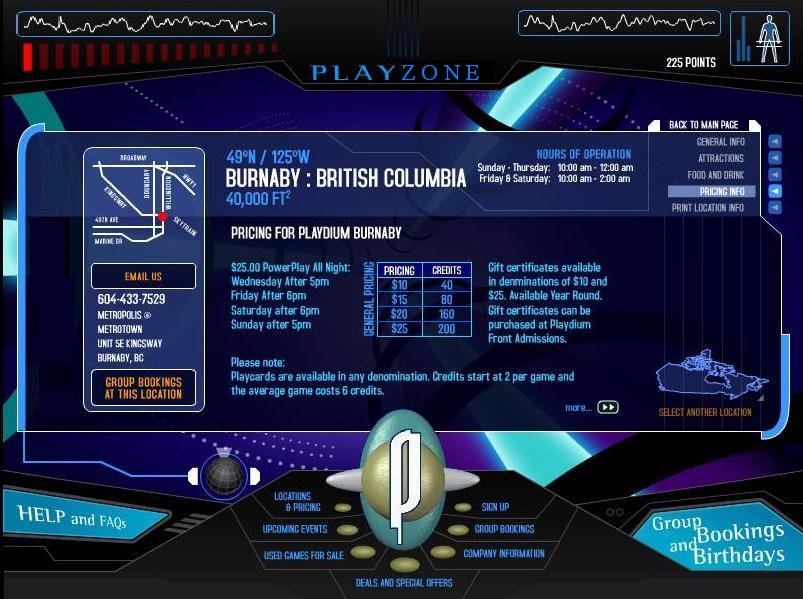
1) Looking at the general pricing, how much is each credit if Mr. Smith purchased a
a)
 $10 playcard
$10 / 40
credits = $0.25 / credit
b)
$15 playcard
$15 / 80
credits = $0.1875 / credit ~
$0.19 / credit
c)
$20 playcard
$20 / 160
credits = $0.125 / credit ~
$0.12 / credit
d)
$25 playcard
$25 / 200
credits = $0.125 / credit ~
$0.12 / credit
2) The smart shopper Mrs. Smith knew immediately
the best deal on this chart and took out $25 to be shared between the 4
children. To challenge her children
however, she did not make any decisions for them but left the problem untouched
and just handed over the money to them.
How could Marcus, Melanie, Sara and Susie have split the money? How many credits would each of them
receive?
Method One
$25
/ 4 = $6.25 each.
Since
playcards are available in any denomination, each of
the four may purchase a playcard of 25 credits for $6.25.
(This
25 cents/credit assumption is from $10/40 credit scale)
Method Two
Buy
a $10 card and a $15 card to get 40 + 80 = 120 credits.
Then
split between the 4 children, that is 30
credits each.
Method Three
Buy
a $25 card for 200 credits.
The
four children will share the same card splitting the 200 credits, which equates
to 50 credits each.



Games start at 2 credits each for classic arcade games like Pacman and goes up to a maximum of 20 credits for Bowlingo, a 10 frames bowling game. Other action games like drumming, dance
revolution, boxing, horse racing, fishing, and canoeing are 8 credits per game
while game-pad simulations like shooting are 6 credits each.
3) What is the maximum number of games that
can be played if
a)
Each
person has 50 credits
50 credits / 2
credits per game = 25 games
b)
The 4
of them share a $25 playcard
$25 playcard = 200 credits available
200 credits / 2
credits per game = 100 games
4) What is the minimum number of games they
can play if
a)
Each
person has 50 credits
This is more a modulo question where we try to fit in the largest credit
game until there is a remainder.
50 credits / 20
credits per game = 2 games with 10 credits left over.
10 credits / 8 credits
per game = 1 game with 2 credits left over.
2 credits / 6
credits per game = 0 game with 2 credits left over.
2 credits / 2
credits per game = 1 game with 0 credits left over.
Therefore the
minimum # of games is 2 + 1 + 1 = 4
games.
b)
The 4
of them share a $25 playcard
We perform a
similar operation for this question as the one immediately above.
$25 playcard = 200 credits available
200 credits /
20 credits per game = 10 games with 0 credits left over.
Therefore the
minimum # of games is 10 games.
5) If the average game costs 6 credits and takes
180 seconds to finish, will 50 credits keep the Smith children busy for the
hour?
50 credits / 6
credits per game = 8.3333 games
180 seconds per
game = 3 minutes per game
8.3333 games x
3 minutes per game = 25 minutes
This means that
50 credits allotted to each child may not last them even half an hour let alone
the hour.
(Unless the
Smith children are way above average in their arcade skills such that they can
hang on and double the time per game!)
6) Using the $20 playcard
bracket, how much does an average game of 6 credits cost?
Under
the $20 playcard bracket, each credit costs $0.125
from $20/160 credits.
Then,
$0.125 x 6 = $0.75 for an
average game.
While the kids are playing their hour away, Mr. and Mrs. Smith went to
study the deals and special offers Playdium has to
offer. Seeing how much the kids are
enjoying themselves, they know they will whine to come again very soon. The two of them note the time play info.
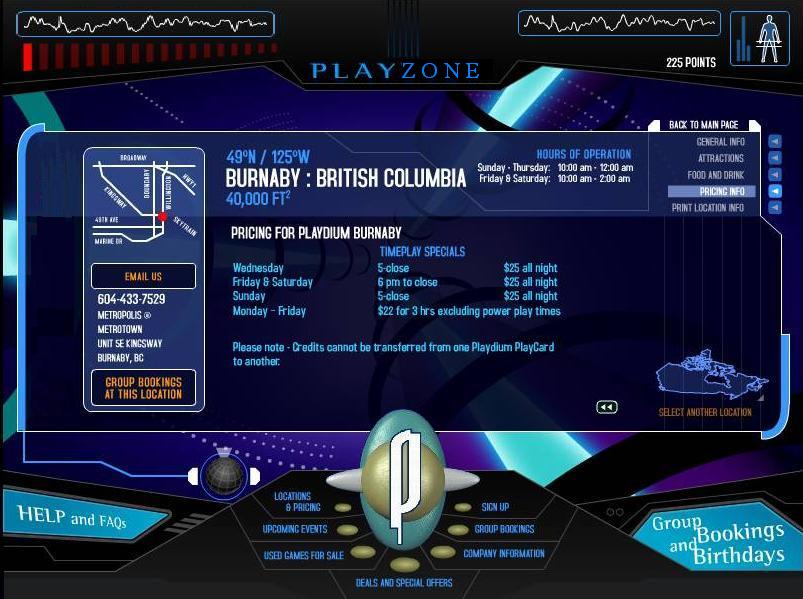
7) If they had not watched a movie today and
came to Playdium directly to spend 3 hours, how could
the Smiths have saved over 50% for an average game?
If an average game lasts 180 seconds (3 minutes), one
can play an average of 20 games per hour.
For three hours, that is 60 games.
If the $22 for 3 hours of unlimited play package is
purchased, that equates to $22 / 60 games, which is $0.37 a game.
One of the attendants offered Mr. and Mrs. Smith the Playdium
Summer Special insert that advertises for Time Play Special, Summer Daze and
More Daze.

8) Compare the Time Play Special with the
regular Time Play pricing. Are
these specials a better deal?
|
|
|
Maximum Hours |
Regular Price |
Price Per Hour |
|
Wednesday |
5 -
12 |
7 |
25 |
3.571428571 |
|
Friday &
Saturday |
6 - 2 |
8 |
25 |
3.125 |
|
Sunday |
5 -
12 |
7 |
25 |
3.571428571 |
|
Mon - Fri |
Any |
3 |
22 |
7.333333333 |
|
|
|
Maximum Hours |
Summer Special |
Price Per Hour |
|
Wednesday |
3 -
12 |
4 |
22 |
5.5 |
|
Saturday |
8 - 2 |
4 |
25 |
6.25 |
From the charts, we can see that the so-called Summer
Specials are in fact more costly if you take advantage of the maximum play
time. However, 7 to 8 hours of
arcade straight can be way too straining for anyone! Even though the price is so cheap, it is
absolutely NOT recommended.


9) The Family Fun Sunday caught your eye.
a)
If you
were to buy the Playcards and pizzas separately, what
is the actual value of the package?
4 x $20 + 4 x
pizza = Over $100 value as per advertisement.
(This means
that the pizzas are over $5 each)
Side note:
Remember back in those days, how much did McDonald¡¦s charge for personal
pizzas?
b)
If you
didn¡¦t go to Playdium for food but just for arcade,
how much is Playdium paying you to try their pizzas?
The actual
costs of the playcards are $80.
Since this
package only costs $69.95, Playdium is paying you
$80.00 - $69.95 = $10.05 to try their pizzas.
c)
How
much does each pizza cost in this case?
Instead of
paying over $5 for each of the 4 pizzas, the cost is -$2.5125 ~ -$2.51 per
pizza.
This means that
for each pizza, you are actually getting $2.51 back!
d)
Can you
think of similar promotions from other organizations?
This
question is open for discussion.
10) As a parent, which of the Summer Daze promotion
is your favourite? Why? How different would that be if you were
a child?
This
question is open for discussion.