Math Trail
Lions' Gate Bridge
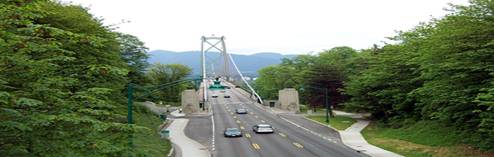
Lions' Gate Bridge Information
The Lions' Gate Bridge is one of the oldest and best used of the 15 bridges in the Lower Mainland. As well as linking Vancouver and the Lower Mainland to the communities on the North Shore of the Burrard Inlet, the bridge is also the starting point for travelers heading to Squamish, Whistler or to Vancouver Island and the Sunshine Coast via the BC Ferries terminal at Horseshoe Bay. Its relation to these destinations is reflected in the fact that its heaviest usage is during the summer tourist months.
|
Structural Type: |
Suspension bridge |
|
Function: |
|
|
Location: |
|
|
Built: |
1937 - 1938 |
|
Owner: |
Government of British Colombia |
Persons Involved:
|
designer: |
|
|
engineer: |
Technical Data
|
Materials: | |
|
Superstructure, cables, pylons, deck truss steel | |
|
Dimensions & Quantities: | |
|
total length of the bridge including the north viaduct |
1, 823m |
|
the main span of the bridge |
472.75 m |
|
span lengths of main bridge |
187.28 m - 472.75 m - 187.28 m |
|
tower height |
111 m |
|
number of vehicles pass through the bridge per day |
60,000 – 70,000 |
|
the speed limit of the bridge |
60 km/h |
|
the average number of vehicles on the bridge on any weekday |
80 |
|
number of vehicles on the bridge at peak times |
180-240 |
|
number of the switched lane control system Data courtesy of: Structurae |
10-15 times per weekday and 15-20 times per day on a weekend depends upon the flow of traffic and various special events |
|
The peak hour volume during rush hour is 5,250. Our daily volume varies from 60,000 to 70,000 vehicles. The counter flow operation includes the Lions Bate Bridge as well as the Stanley Park Causeway. The total length is 4 km. Cimplicity (a computer program) monitors and controls the lane control system. There are from 120 to 360 people in 80 to 240 cars on the bridge at any time, not including buses and people in buses.
|
|
|
Currently, the most recognizable parts of the structure, the towers and suspension cables, remain in good condition. However, over 60 years of constant traffic coupled with the corrosive effects of rain and salt, the steel and concrete roadway are in need of major improvements. Annual maintenance costs have escalated (exceeding $3 million annually) and traffic restrictions were imminent if repairs were not undertaken. Luckily repairs have been underway. Prior to the project of replacement and rehabilitation, the Lions Gate corridor had one of the highest crash rates in the Lower Mainland. Improvements to the bridge and Causeway provide a safer and more reliable facility for motorists, cyclists, and pedestrians. The cost of replacement and rehabilitation of the Lions Gate Bridge was about $125.0 million. As a result, traffic lanes was widened from 2.9 m (9.5 ft.) to 3.5 m (11.48 ft.). Sidewalks were widened from 1.3 m (4.26 ft.) to 2.67 m (8.75 ft.) with 2.0 m (6.56 ft.) clear width for safe cycling and pedestrian access. Work on the Causeway commenced in July 1999. Deck replacement commenced in September 2000 and was completed in September 2001. The project was substantially completed in December 2001, with final paving planned in spring 2002, during favorable weather conditions. Beginning at 10:00 p.m. to 6:00 a.m. a series of evening and weekend detours began on the Lions Gate Bridge, to allow for the replacement of the bridge deck. Traffic was detoured to the Ironworkers' Memorial Second Narrows Bridge during these necessary closures of the bridge but it was quite remarkable that the Lion's Gate was never closed for a period longer than 4 days at a time (although the number of lanes was reduced through most of the improvement phase). | |
Lions' Gate Bridge Math Problems
1) The total length of the Stanley Park Causeway and Lions' Gate Bridge is 4 km. If the total length of the bridge alone is 1823m, what is the length of the Stanley Park Causeway? Solution
2) The total length of the Lions' Gate Bridge including the north viaduct is 1823m. Span lengths of the main bridge are 187.28m, 472.75, and 187.28m. Find the length of the north viaduct. Solution
3) (BONUS QUESTION) The central cable of Lions' Gate Bridge forms a parabolic arch. The cable is suspended from the top of two supporting towers 472.75m apart. The top of the tower is 60m above the road and the lowest point on the cable is midway from the towers and 5m above the road. Find the height of the cable above the road 40m from a tower. Solution
4) The average number of vehicles on the Lions' Gate Bridge on any weekday is 80. The average weight of each vehicle is 800kg. The average number of people in each car is 2 persons. The average number of pedestrians is 50 and biker is 10. Average weight of each person is 80 kg and each bike is 20 kg. If total weight of vehicles and people on the bridge is considered as active load, find it on any weekday. Solution
5) a) The total length of the Stanley Park Causeway and Lions' Gate Bridge is 4 km. The average speed of most cars travelling over the bridge is 50 km/h (in light traffic). How long does it take to cross the bridge and Causeway given the average speed?
b) During peak times - the bridge gets very congested. The average speed is definitely much slower than the usual 50 km/h. If the average speed gets reduced to 25 km/hr how long does it take to cross the bridge.
6) The average number of vehicles pass through Lions' Gate Bridge to Vancouver down town is 65000. Average number of people in each car is 2 persons. Find the average number of people per year who pass through Lions' Gate Bridge to Vancouver down town. Solution
7) In May 1999, a budget of $99.9 million was authorized by cabinet for the Lions' Gate Bridge project; and an $88.6 million contract was awarded to American Bridge/ Surespan. In January 2000, an additional $8.2 million was allocated to the project budget. On November 7, 2001 cabinet endorsed a $16.9 million budget adjustment. How much is the total budget for the Lions' Gate Bridge project? Solution
8) The speed limit on Lions' Gate Bridge is 60 km/h, and total length of the bridge including the north viaduct is 1,823 m. How much time is needed to pass the bridge with the maximum speed? Solution
9) If you know the daily volume of vehicles (from 60,000 to 70,000) pass over the Lions' Gate Bridge representing more than 40 per cent of the daily trips across Burrard Inlet, determine the total trips across Burrard Inlet via Lions' Gate Bridge and Second Narrow Bridge. Solution
10) The number of vehicles that cross the Lions' Gate Bridge each day varies between 60,000 and 70,000. Using these numbers determine the total number of vehicles that cross over the bridge on an annual basis. Solution
11) (BONUS QUESTION) Determine the equation of a quadratic function that passes through the point of origin and ( 196.375, 37.946 ). Find the axis of symmetry and the y-intercept of the function. Solution
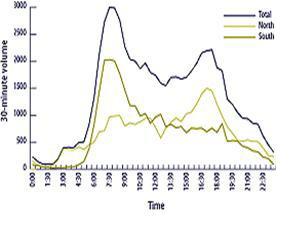
12) According to the following graph, estimate the average number of vehicles crossing the Lions' Gate Bridge during rush hours in the morning ( 7:30- 9:00 a.m.) and in the afternoon ( 4:00-5:30 p.m.).
 |
13) As a result of the Lions' Gate Bridge replacement and rehabilitation, traffic lanes were widened from 2.9 m to 3.5 m. The number of lanes - three lanes - remained unchanged. Two sidewalks were widened from 1.3m to 2.67m with an additional 2.0 m clear width for safe cycling and pedestrians’ access. Determine the total width of the Lions' Gate Bridge. Solution
14) The initial construction of the Lions' Gate Bridge was completed in 1938. How old is the bridge? Solution
15) The Olympics in 2010 will affect the traffic and transportation on the Lions' Gate Bridge. To solve the traffic jam another bridge or tunnel might be built. To fund this effort the B.C. government is considering taking one dollar from each vehicle passing over the bridge (making it a toll bridge). If this occurs, how much money will be collected in five years if the average number of vehicles crossing the bridge daily is between 60000 to 70000? Solution