Documents related to the Academic Integrity Policy process are shared through a system called Maxient. The image below shows what this email will look like for students.
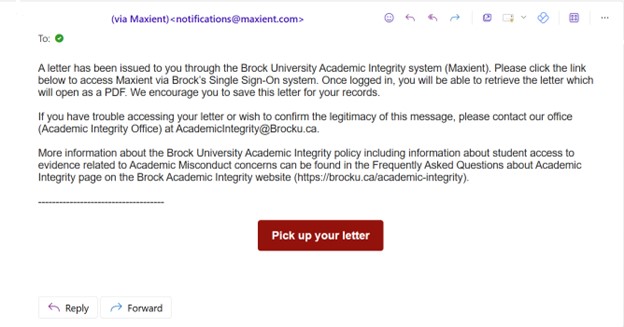
If you receive a letter about a concern, it is important to read the letter carefully and respond within the timeframe indicated. You have 10 business days to confirm your availability for a meeting to discuss the concern.
To respond:
- Follow the instructions in the letter
- Confirm your availability for a meeting
- Indicate if you plan to bring an advisor or support person, such as the Student Ombuds.
The first meeting is an opportunity to discuss the concern and provide any relevant information or documentation that may help clarify the situation.
We recognize that receiving a notification regarding an academic integrity concern may cause stress for students. We encourage students to reach out to the available supports offered by the university.
Students seeking personal counselling can email [email protected] or call 905-688-5550 x5442.
Counselling appointments are available both in person at Brock and virtually, allowing students to choose the format that best meets their needs.
The University offers a range of counselling and psychotherapy services, depending on student needs and clinician assignment, and students will be connected with trained, caring, trauma-informed members of the expanded Brock wellness team who provide confidential support.
Students in crisis and needing urgent support are encouraged to:
- Call 911 in the event of immediate risk.
- Call or text 988 to speak to someone immediately. The suicide crisis hotline is bilingual, trauma-informed, culturally respectful and available to anyone in Canada 24/7.
- Call the Crisis Outreach and Support Team (COAST), which is available 24/7 at 1-866-550-5205.
1-833-BROCK33 number is active for 24/7 crisis service.
For more information about health and wellness services at Brock, or to connect with the team, visit the SWAC website.
Workshops through the Student Wellness and Accessibility Centre and Learning Services are available on an ongoing basis.
The undergraduate procedure is described in Section 8 of Brock’s Academic Integrity Policy.
- First Letter: Students are informed of concerns of potential academic misconduct by a letter shared through Maxient. Students should reply to this letter indicating their availability for a meeting, requesting relevant evidence related to the concern, and indicating if they will bring a support person to the discussion.
- First meeting: Students are invited to a meeting with the course instructor and Department Chair (or designate) to review the evidence. The student can respond, provide their own evidence, or admit responsibility.
- Chair’s Recommendation: At the end of the first meeting, the Chair makes a determination to dismiss the case or inform the Associate Dean of their determination and recommended outcomes (e.g. disciplinary measure, Mandatory Remedial Action workshops).
- Second Letter: The student receives the outcome in the second letter with any recommendations from the Chair to the Associate Dean. Students have 10 business days to request a second meeting with the Associate Dean.
- Second meeting (if requested): The Associate Dean reviews all evidence and hears from the student before making a final decision.
- Final Decision: The Associate Dean determines whether the student is responsible for academic misconduct. The student is informed of the decision and their right to appeal.
If the letter does not specify the assignment or activity involved, you can request clarification as well as the evidence related to the concern.
You may contact the Department Chair or Chair’s Designate listed in the letter to ask:
- Which assignment, test, or activity is under review
- To have the evidence shared with you
The purpose of the first meeting with your instructor and Department Chair (or designate) is to discuss the concern and review related evidence. During the first meeting, you will have an opportunity to ask questions and provide your response to the concerns brought forward by your instructor.
As a student, you have the right to request access to evidence related to the concern raised by the instructor about potential academic misconduct.
To request evidence:
- Submit a written request to the Department Chair or Chair’s Designate listed in the letter.
- Requests should be made no later than two business days before the scheduled meeting.
The Department Chair may determine that evidence must be partially redacted or cannot be shared due to privacy concerns (for example, if another student is referenced). If this happens, you will be informed in writing, and alternative arrangements will be made to allow access to the evidence. See Section 8D (p. 7) of the Brock Academic Integrity Policy for further details.
If you do not respond to the letter within 10 business days, the academic misconduct process may proceed without your participation.
This means the discussion about the concern will proceed between the instructor and department Chair. A decision may be made without you present, and a recommendation made to the Associate Dean based on the available evidence.
For this reason, it is strongly recommended that you respond within the timeframe indicated, even if you need additional time to prepare or schedule the meeting.
The Office of the Student Ombuds is an independent resource available to Brock students. Their role is to:
- Listen to student concerns.
- Identify and explain relevant Brock policies and procedures.
- Help students understand the University system.
- Discuss and evaluate next steps with students.
- Give students tools to communicate and advocate for themselves.
- Manage conflicts.
- Use informal channels to help students resolve problems.
The Student Ombuds does not advocate for either side of the case. Instead, they provide guidance to ensure the process is fair and that students understand their rights and responsibilities.
Contact information for the Student Ombuds is available on the Office of the Student Ombuds website.
If you have questions about the process or the policy, you may contact:
- The Department Chair or Chair’s Designate listed in your letter
- The Office of the Dean for your faculty
- The Student Ombuds
- The Academic Integrity team at [email protected]
If you are found responsible for academic misconduct, there may be disciplinary measures including (but not limited to):
- Required educational/remedial activities (e.g., attendance of workshop, or resubmission of assignment, etc.)
- Grade penalties (e.g., reduced grade, failure on an assignment, or failure in the course)
- Transcript notation
- Restrictions or removal from programs (e.g., co-op, internship, or program of study)
- Suspension or permanent removal from the University
- In serious cases, a degree or certificate may be withheld or rescinded
For more information, please see Section 10 (p. 13) of the Brock Academic Integrity Policy for further details.
Yes, you have the right to appeal certain academic misconduct decisions.
If a decision has been made by the Office of the Dean, you may appeal the decision to the Student Senate Appeals Board.
Information about the appeals process, timelines, and requirements will typically be included in the decision letter you receive.
You may also wish to consult the Student Ombuds for guidance before submitting an appeal.